
AI Deep Dive: Wealth Management
Human-only advice struggles to serve India’s complex middle at mass-market price points. While AI changes the cost curve, the winner will be who cracks distribution, accountability and permissions.
Over the past two months, we spoke with founders building AI-native wealth products, with operators who scaled some of India’s largest investment platforms, and - perhaps most usefully - we looked at our own portfolios.
A de-identified composite from those conversations captures the problem. A financially sophisticated professional had accumulated dozens of mutual funds across multiple platforms: active SIPs alongside forgotten one-time investments, overlapping exposures, no clean way to decide what to keep, exit, or ignore. The returns were fine. The management was chaos.
India is not short of financial products. It is short of someone - or something - coordinating them. The missing loop is insight → action → trust: understand the household, help it make and complete a suitable decision, remember what happened, and show up again when circumstances change.
That loop has never closed at scale because the labour required to close it costs more than most households are worth to serve. AI attacks exactly that cost. But cheaper intelligence does not automatically produce trust, permission to act, or a durable business - and the mistake most “AI wealth” pitches make is assuming it does.
Part I - Why the loop never closed
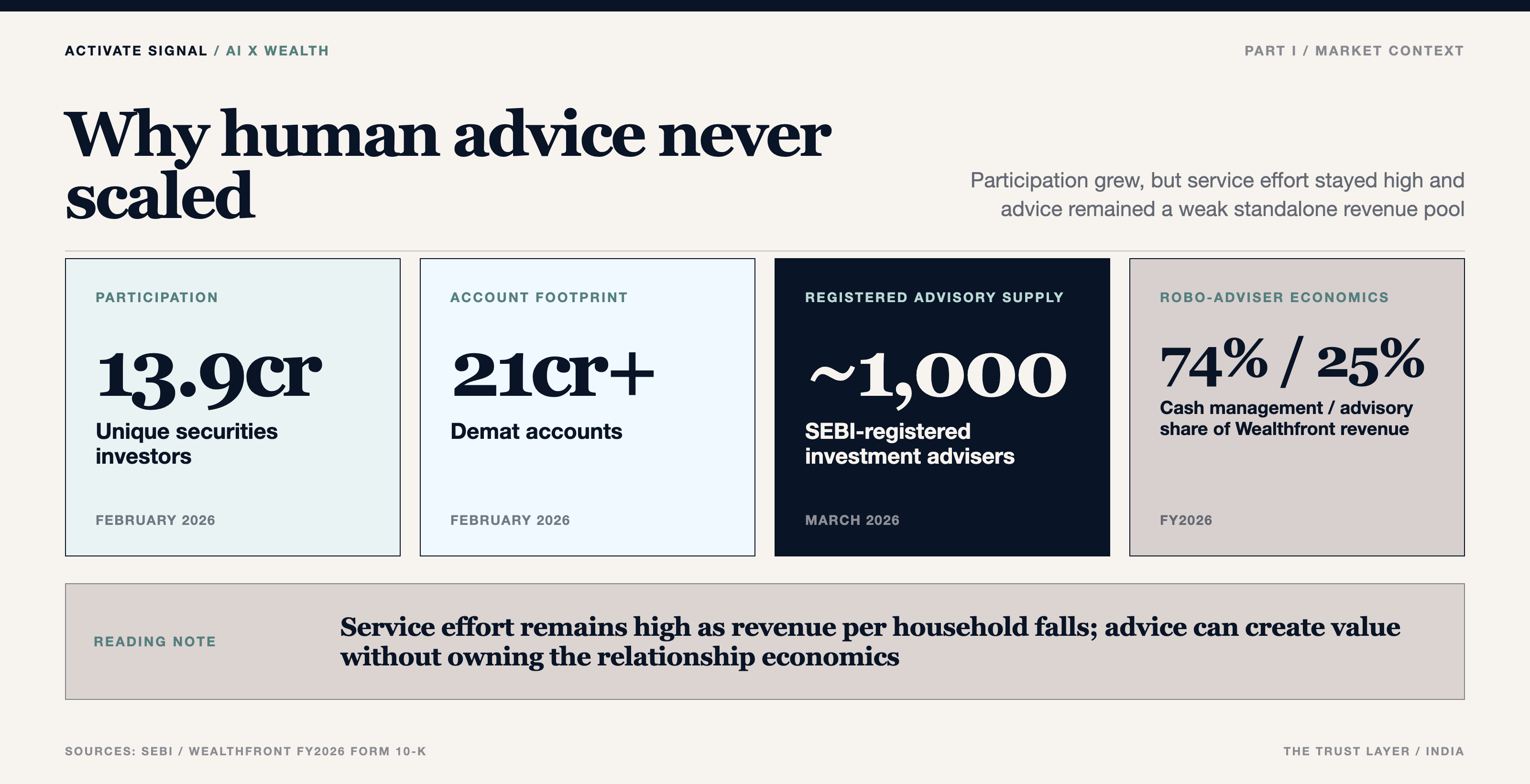
India’s investing population has expanded faster than its advice infrastructure: roughly 13.9 crore unique securities investors and over 21 crore demat accounts in early 2026, against around 1,000 registered investment advisers. Banks and brokers fill some of the gap, but they distribute products or service wealthy relationships - very little of that supply continuously coordinates an ordinary household’s financial life.
The economics explain why. Good advice is not one portfolio recommendation a year; it is reconstruction, explanation, suitability checks, execution, monitoring, and intervention when a workflow breaks. That work does not scale down - as the wallet shrinks, revenue per household falls faster than the effort to serve it. So advisers move upmarket, platforms simplify, and the household coordinates the rest.
Robo-advisers digitised the portfolio, not the adviser. Fifteen years on, two independent survivors: Wealthfront’s FY2026 filing shows $94.1B in platform assets, 74% of revenue from cash management against 25% from advisory, and Betterment has been stuck near $1.3B since 2021. Our read: at the category’s best outcome, advice earns a quarter of the revenue - valuable, but not the business. Advice is a wedge; spread is a business.
What AI changes is not the model. It is the price of the wedge. Robo 1.0 paid roughly $650 to acquire an account; Cleo built a $300M revenue business at around $11, because the product itself does the acquiring. Two orders of magnitude - and at that price three segments become servable instead of one.
Part II - One market, three definitions of wealth
The right segmentation is not by AUM band but by what wealth means to the user - because the definition of wealth determines the value lever, the value lever determines the business model, and the business model determines what kind of company you are underwriting. Run that across the pyramid and five demographic tiers collapse into exactly three plays.
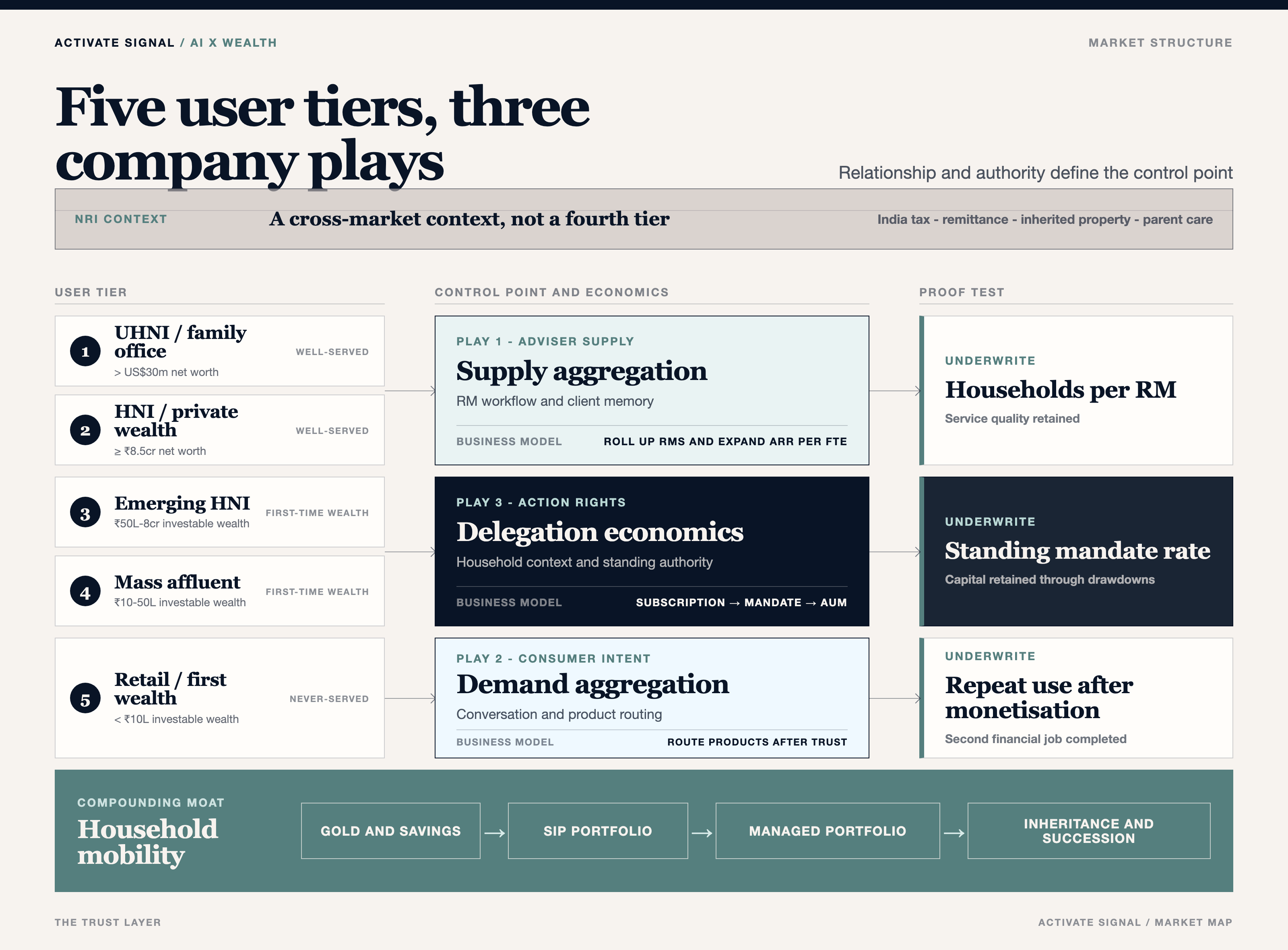
Play 1 - Supply aggregation: the AI-native Anand Rathi. At the top - roughly 19,900 UHNWIs and 8.7 lakh millionaire households - the user is not underserved but expensively served, and happily so. Wealth means preservation, succession, access, and the relationship manager already owns the trust. Alpha pitched against an engaged RM is a losing proposition, so own the RM instead.
The incumbent template’s economics are public: Anand Rathi Wealth runs 417 RMs managing ₹249 crore each - roughly ₹3 crore of revenue per RM, 33 client families per RM, at ~34% PAT margins. The AI proposition reduces to hours saved, workflows automated, tasks outsourced, all rolling into ARR per FTE. The US has validated the shape at Savvy Wealth and Farther. The twist for India is downward: margin expansion is the entry, but if AI takes an RM from 33 families to 100+, the ₹50 lakh-₹2 crore emerging-HNI tier becomes reachable at premium quality.
Play 2 - Demand aggregation: trust routing for the never-served. At the base, wealth is not a portfolio. It is a credit score, a loan, gold, insurance, a savings account. This user arrives with ambiguous intent - no deadline, no portfolio to diagnose, no job they can name. Acquisition cannot begin with a diagnosis, because there is nothing to diagnose.
So the wedge must meet their definition of wealth, and the best-proven one is the credit score: 183 million Indians self-monitor their CIBIL score, 75% of them outside the metros. Paisabazaar built its engine on 60 million free credit-score users who now drive 70-75% of loan disbursals as repeat customers; Jar proved the gold version at 35 million users, over 95% first-time savers, profitable. The AI-native version is conversational - PAN in, score out, then a surface where the user asks what wealth means for them, in their own language. Value capture is demand aggregation: accumulate trust, then route it into loans, insurance, gold, eventually funds. Our read: the hard part is not the routing. It is holding the trust while you do it.
Play 3 - Execution delegation: closing the behavior gap. In the middle sits the user this piece opened with, and the standard framing needs one correction. Her binding constraint is not advice. It is execution. She watches the content, holds the opinions, already knows the diagnosis, and still cannot act. The 43-fund portfolio nobody exits. The SIP nobody rebalances.
The cost is quantified: Axis Mutual Fund found equity funds returned 18.7% CAGR while the average investor in those same funds earned 13.2% - a 5.5-point behavior gap from timing errors, churn and panic exits.
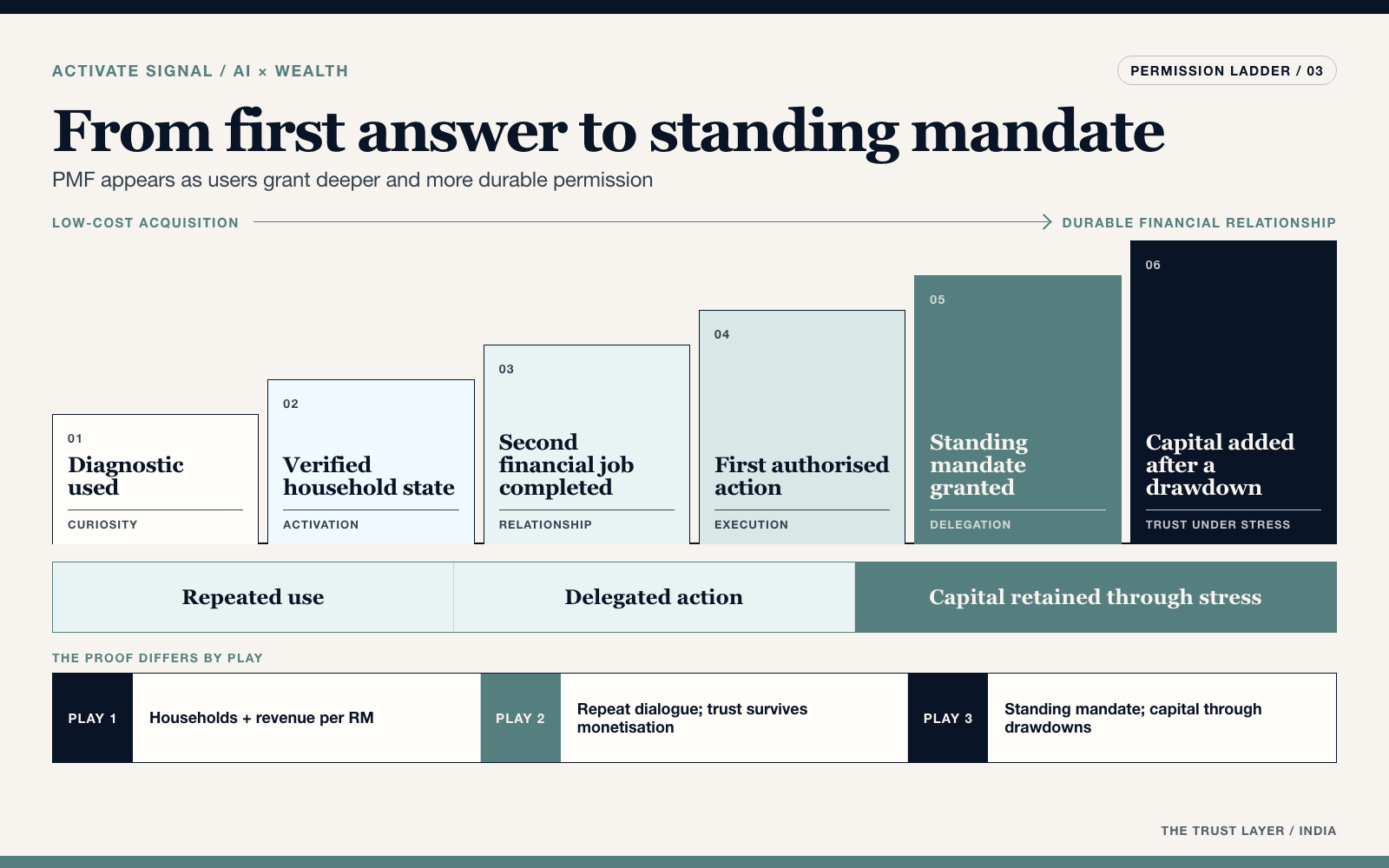
That gap is the product. An AI agent here does not need to beat the market; it needs to beat the user’s own execution. Execution alpha, not information alpha - a categorically easier claim to deliver and to regulate. The ladder is a sequence of delegation proof points: diagnose, recommend, execute-with-approval, standing mandate.
Two overlays. The NRI diaspora - 3.7 crore overseas Indians - is a context, not a tier: remittance, India tax filing, inherited property, parent care. It attaches to any play. And household mobility connects the tiers over time - today’s gold saver is 2032’s mass-affluent professional, whose parents’ succession event is the largest wealth transfer in the family’s history. The platform that owns the transition between definitions of wealth captures the migration every static segmentation misses. That is what a household-level financial graph is ultimately for.
Part III - When the user actually shows up
Segmentation tells you who to build for. It does not tell you when they are reachable, and in wealth, that second question decides acquisition entirely. Households do not switch providers because a better product exists. They switch when something happens.
Mapping those moments against the pyramid produces a sharper picture than any AUM band:
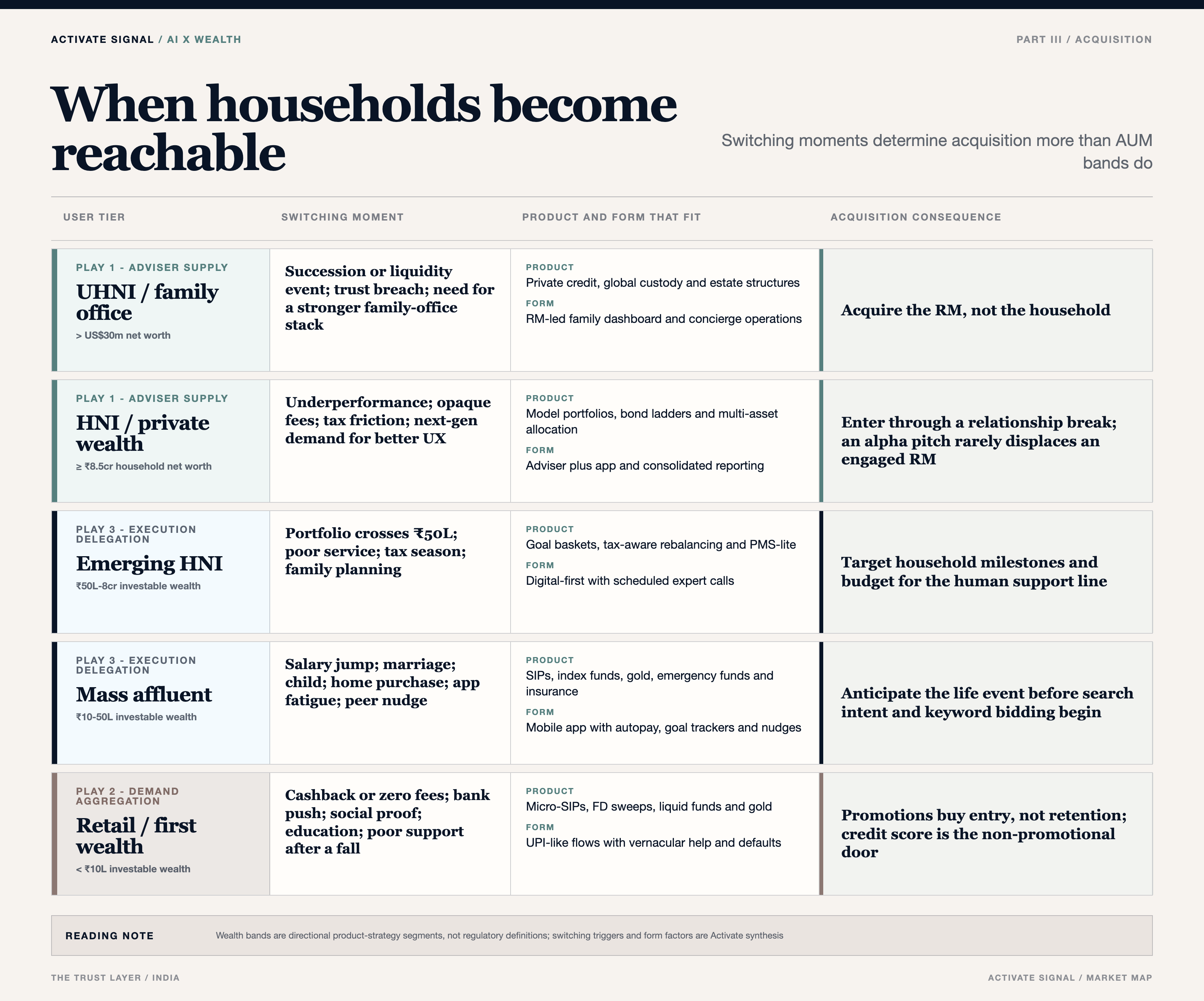
Three things fall out.
The middle switches on life events, not returns. None of those triggers is a financial-product event; all are calendar events a system holding a household graph can anticipate. The graph is usually defended on retention grounds. It is really an acquisition asset - you do not need to outbid Groww on keywords if you know a user’s second child is due.
Every trigger at the base is promotional. Cashback, a bank push, social proof, an employer nudge. Not one is a product-quality trigger, so the channel that demonstrably acquires the never-served user has the worst retention economics. That is the real argument for the credit-score wedge: it is the only non-promotional door into that tier.
Play 3 is two form factors. The emerging-HNI user wants a scheduled expert call; the mass-affluent user wants autopay. Same constraint, different cost structure - and that discontinuity is where a Play 3 company either finds software economics or discovers it has built a services business.
Part IV - What you would have to believe
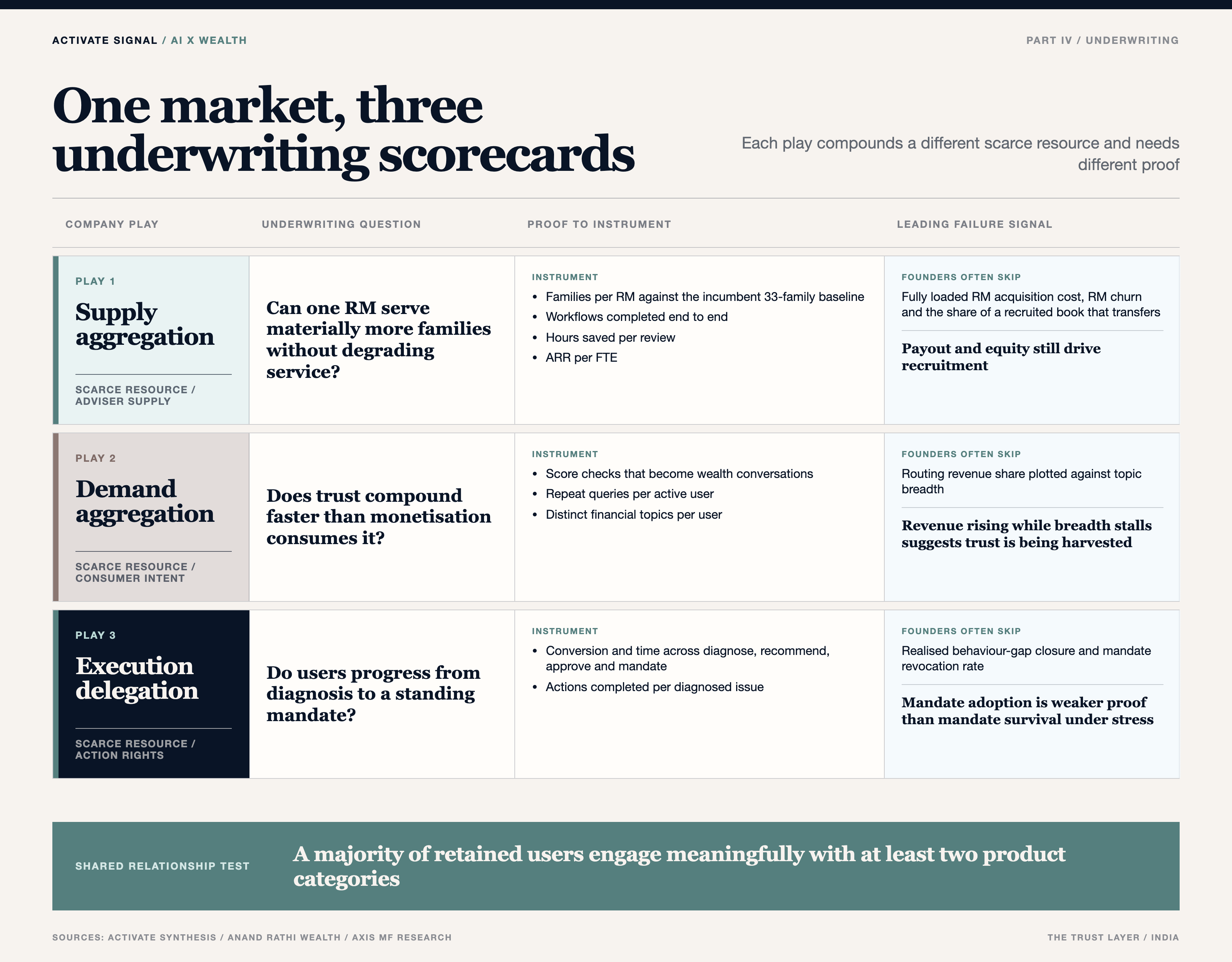
Three plays are three companies, so one scoreboard will not do. Each measures a different word in the loop: Play 1, whether insight got cheap enough to produce at scale; Play 3, whether insight converts to action; Play 2, whether action accumulates into trust rather than spending it.
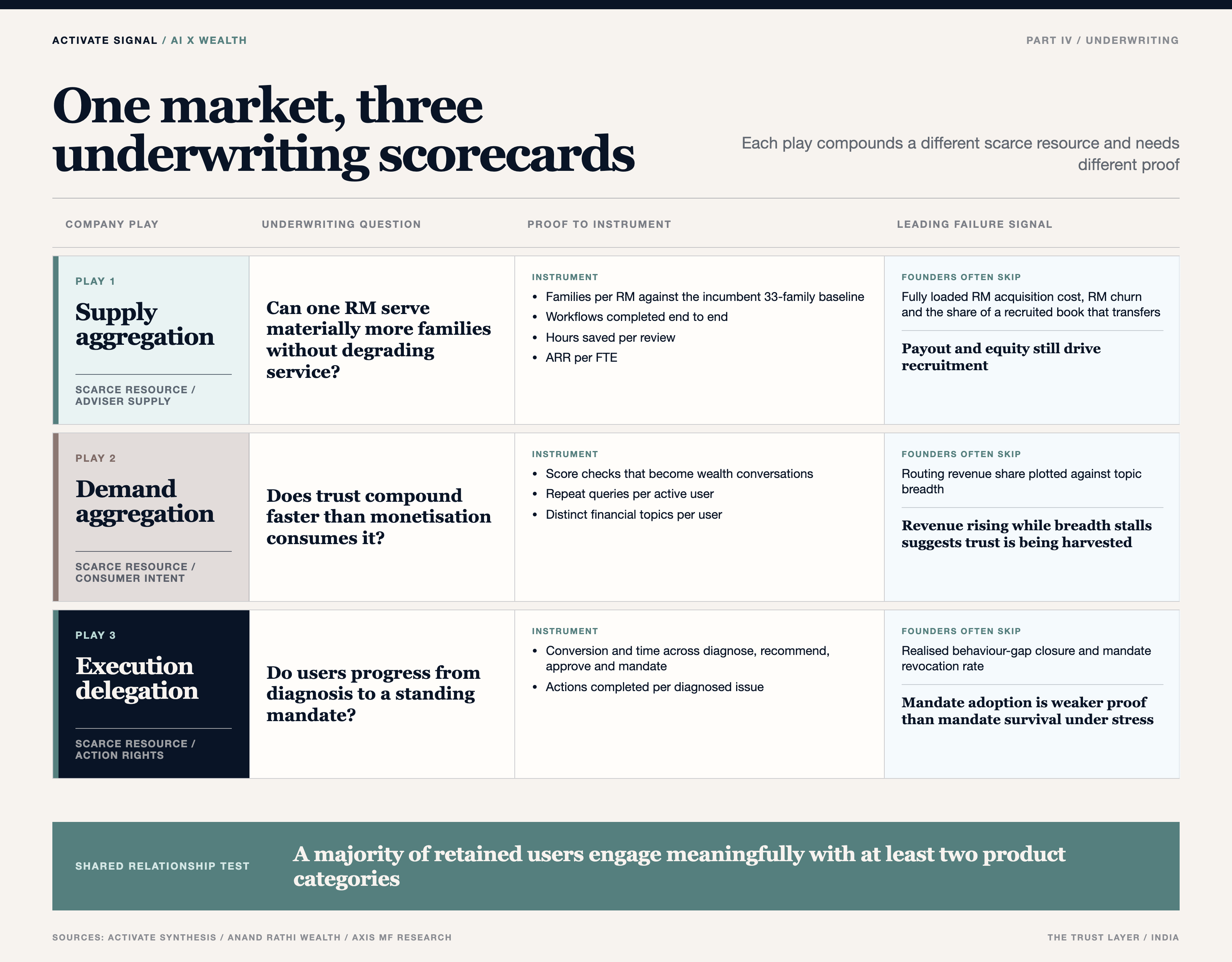
What would prove us wrong. Three things, in ascending order of damage. If households per RM does not move within twenty-four months, Play 1 is a services business wearing software pricing - and note that Savvy and Farther both publish AUM growth and conspicuously not revenue-per-advisor deltas, so the productivity claim is unproven even in the market that pioneered it. If Play 3 users stall permanently at execute-with-approval and never grant a standing mandate, the delegation ladder has a missing rung and the AUM relationship that pays for everything never arrives. And the largest risk sits under the whole thesis: it assumes households eventually punish misaligned advice. Indian consumers have tolerated mis-selling for thirty years without moving their money. If alignment turns out to be something users say they want and never pay for, the independent's moat is a preference, not a structure - and the brokers win on distribution exactly as they always have.
Part V - What it looks like when it works
July 28th, 11 pm. A product manager uploads her Form 16. Ninety seconds later her return is drafted - the least of it. The agent has also noticed ESOP capital gains that change her advance-tax position, ₹3.2 lakh idling at 3% against a personal loan at 14%, and two ELSS funds bought for a deduction she no longer claims. It files, then asks one question: your loan is costing you ₹34,000 a year more than your idle cash earns - want me to set up the prepayment? That second permission is the whole business.
The claim. A user’s father is hospitalized. The agent already holds the family’s policies. Within the hour: pre-authorization drafted, exclusions checked, the room-rent sub-limit flagged before the family chooses a room - the clause that quietly shreds thousands of claims. When the insurer pays 71%, it drafts the escalation with the policy language cited. One founder told us about a user who, facing surgery with no one to call, fed his policy into an LLM just to understand his coverage - and came out feeling more secure than any agent had made him feel. Security manufactured at the moment of need is the deepest trust event in consumer finance.
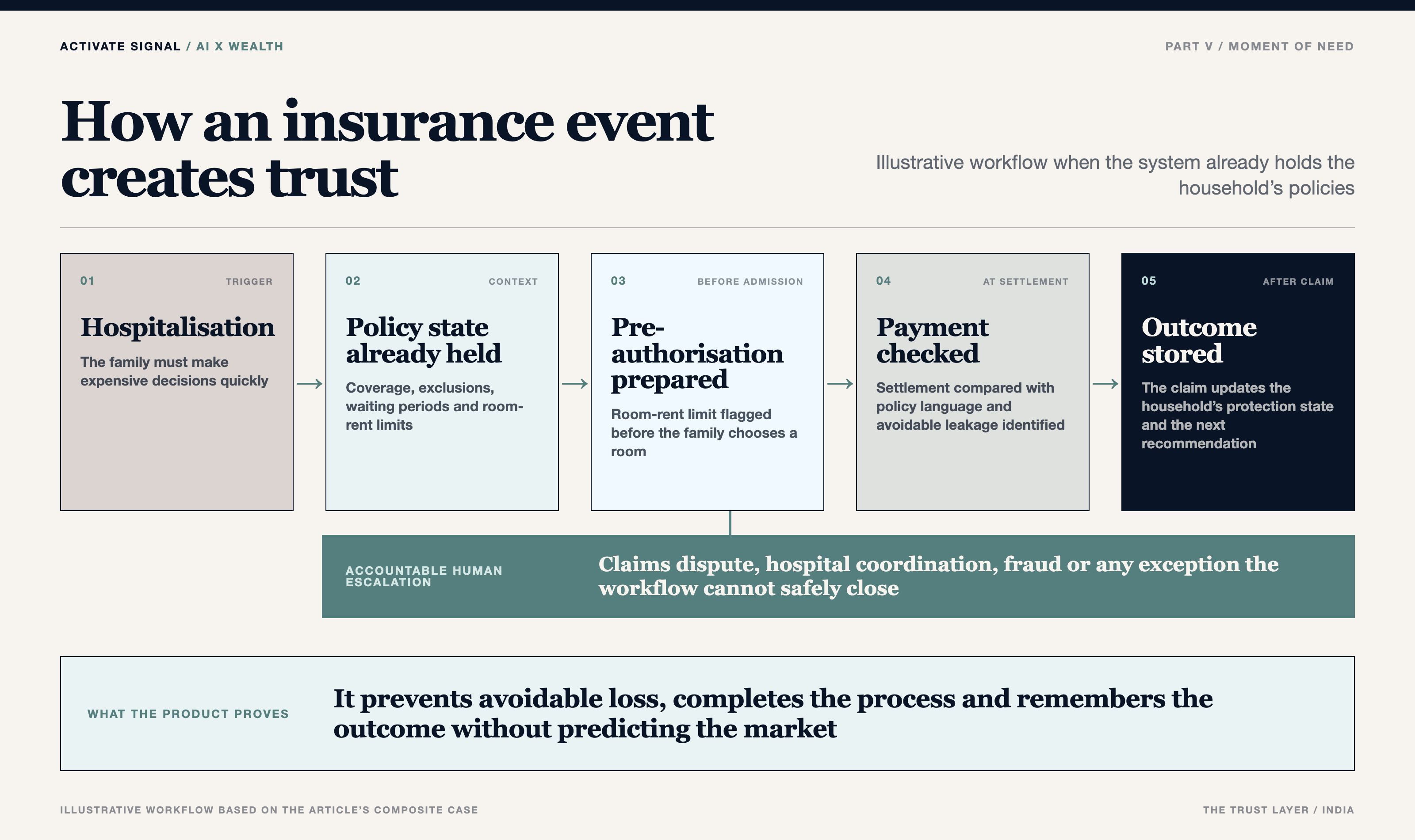
Note what is absent from both: a stock tip. The AI never predicts the market. Everything it does is deterministic or near-deterministic - leakage, structure, protection, process, productivity.
Part VI - Where new company formation opens up
Part III mapped when a household changes provider. There is a second trigger, and it is the more valuable one: when a household changes what it holds. A distributor switch moves share between existing players. A form-factor switch creates a category.
Those transitions are legible per tier. The top of the pyramid moves into private credit, global custody, AIFs and estate structures - it is buying access and orchestration. The middle moves from single SIPs into goal baskets, tax-aware rebalancing, PMS-lite and loans against securities - it is buying transparency plus human backup. The base moves from a savings account or FD into a micro-SIP, a liquid fund, gold - it is buying confidence, defaults, and a frictionless first step.
Five companies sit on those transitions.
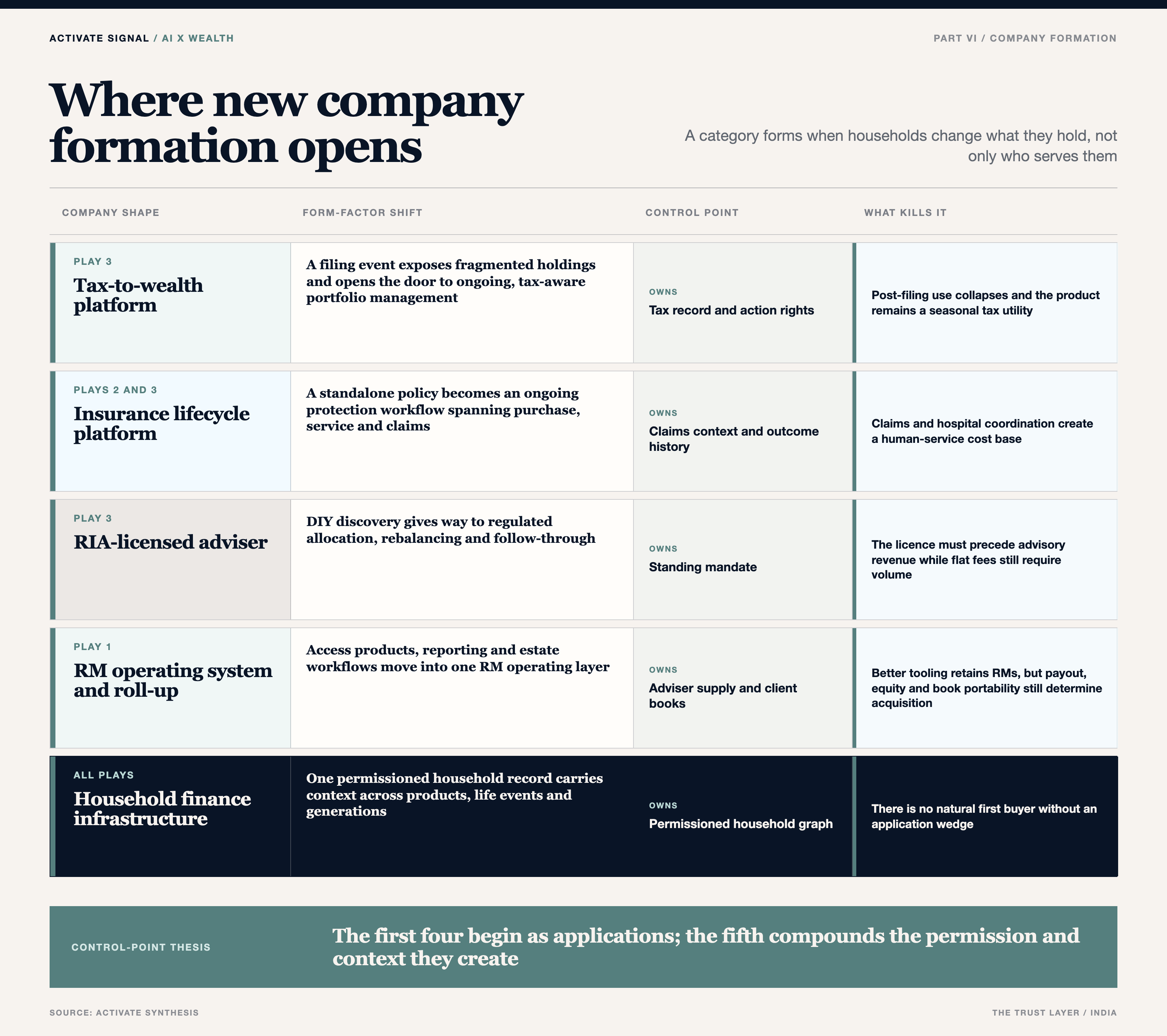
The first four are applications. The fifth is what they all leak into, and it is the only one whose asset is permission rather than product. A broker owns an account, an insurer a policy, a tax platform a filing history. The household graph is the first thing in Indian finance that can affordably own the household - and a competitor cannot copy a permission it was never granted.
Which is also the answer to the obvious objection, that Groww or CRED will simply ship all of this. They will bolt on AI, and they start with distribution independents cannot buy. But transaction platforms carry a structural conflict into advisory: their revenue is activity, and honest advice frequently means less of it. An AI adviser owned by a broker is a chatbot with a conflict of interest.
Can one company run two plays? The question every founder reading this will ask, and our own argument forces it: the Play 1 endgame - an RM serving 100 families instead of 33 - is Play 3’s customer, reached from the supply side. So the plays converge downward on the emerging-HNI tier from opposite directions, one carrying a human and one trying not to. Our read is that the convergence is real but the sequencing is not optional. Play 2 and Play 3 can share a company, because they share a consent model and a graph; a user acquired on a credit score can be graduated into execution delegation on the same permissions. Play 1 cannot be bolted on, because acquiring RMs is a recruiting business with a balance sheet, not a product motion. Anyone pitching all three at seed is pitching a holding company.
The professional we opened with does not need a better dashboard telling her she owns 43 funds. She needs something that knows which seventeen overlap, is allowed to exit them, remembers why it did, and is there in eighteen months when her father is hospitalised, or her portfolio crosses ₹50 lakh. That is one system, not three products.
The winning companies will not be the ones that generate the most recommendations. They will be the ones a household - or a relationship manager - trusts to remember, to act, and sometimes to leave things alone.
India AI News Roundup
The most important AI developments shaping India’s market structure this month.
Sarvam’s board approves a $74M Series B extension led by NVIDIA at a $1.51B valuation
RBI’s draft Model Risk Management guidance puts every AI model under a board-owned framework
Emergent becomes a unicorn with a $130M Series C led by Creaegis, thirteen months after launch
IndiaAI Mission picks 20 sovereign models - 12 LLMs and 8 SLMs - with 93 lakh GPU hours sanctioned
Startup Signals
Early AI companies from India we are watching because they point to where the market may be forming.
Oolka: An agent that works your credit file, not your questions
Oolka deploys AI agents that act on a user’s credit profile rather than reporting on it - closing dormant accounts, disputing bureau errors, negotiating rates with lenders on the user’s behalf. Founded 2024 by a former Meesho executive; $14M Series A led by Accel at ~₹730 crore post, six million users, roughly a hundred regional languages.
Why it matters: every credit app in India tells you what is wrong and almost none fixes it. If the first experience of financial help is a completed action rather than a diagnosis, the trust ladder starts a rung higher than the category assumed.
GoodScore: The same wedge, sold as a subscription
GoodScore attacks the identical entry point with the opposite model - AI-led guidance, expert calls, a lending marketplace underneath. $13M Series A led by Peak XV, five million-plus users, ₹6,200 crore of loans under management, and ₹99 a month.
Why it matters: one monetises the action, the other the advice. A base-of-pyramid platform charging directly for guidance is the sharpest live test of whether trust can be sold, or only brokered.
thrive.money: Read-only diagnosis, one authorised action
thrive.money is pre-launch and waitlist-only, and still the crispest statement of Play 3 we have read: connect read-only, surface what your money quietly costs you, execute the single action you choose. The homepage leads with “investment adviser registration pending” rather than a growth number.
Why it matters: sequencing the licence before the user base is expensive and slow, and the only order that works if the endpoint is a standing mandate.
Draconic: Conviction as the product, not execution
Draconic runs specialised agents across price action, options flow and sentiment, resolving into a documented reason for every trade. India-built, globally sold across thirty-plus markets, backed by WEH Ventures.
Why it matters: it states plainly that it is not a registered adviser, and that constraint shapes the product rather than merely disclaiming it. Selling reasoning the user acts on themselves is the ceiling on what an unlicensed AI wealth product can capture.
FinStocks AI: Strategies you can read before you run them
FinStocks AI turns a prompt into a strategy the user can read, edit, and mock-test, then run on their own broker account. Custody never leaves the broker; the stop stays with the user. Early, no disclosed funding.
Why it matters: the bet is that the answer to black-box scepticism is legibility rather than track record. Whether a readable strategy survives its first drawdown is the question the whole category owes an answer to.