
AI Isn't Killing IT Services
It's collapsing the delivery pyramid, reshaping where margins accrue, and creating new winners across startups & GCCs.
Two things are happening to IT services at once, and they pull in opposite directions.
The first is deflation. Every hour of work an agent can now do - a migrated codebase, a resolved L1 ticket, a reconciled ledger - is what the market stops paying full freight for. TCS shed roughly 28,550 people in nine months while revenue per employee rose 3.6%. Persistent’s renewal TCV dropped 10.9% in a single quarter, entirely in contracts.
The second is creation, and it is the Jevons paradox doing its familiar work: when the unit cost of a capability collapses, total consumption of it rises. Cheaper, faster delivery does not shrink the market. It pulls forward demand that never had an economic path before. Infosys’s subcontractor spend grew 19.2% year-on-year, twice the rate of internal staff costs. Wipro booked $7.8B in large deals, up 45.4%, while current-quarter revenue fell 1.6%. Record bookings against declining revenue is the signature of an industry mid-transition.
So the map is not shrinking. It is being redrawn.
To see where the value goes, you first have to read the map honestly: IT services is not one market, and AI is not pressuring it evenly.
The AI Disruption Matrix for IT Services
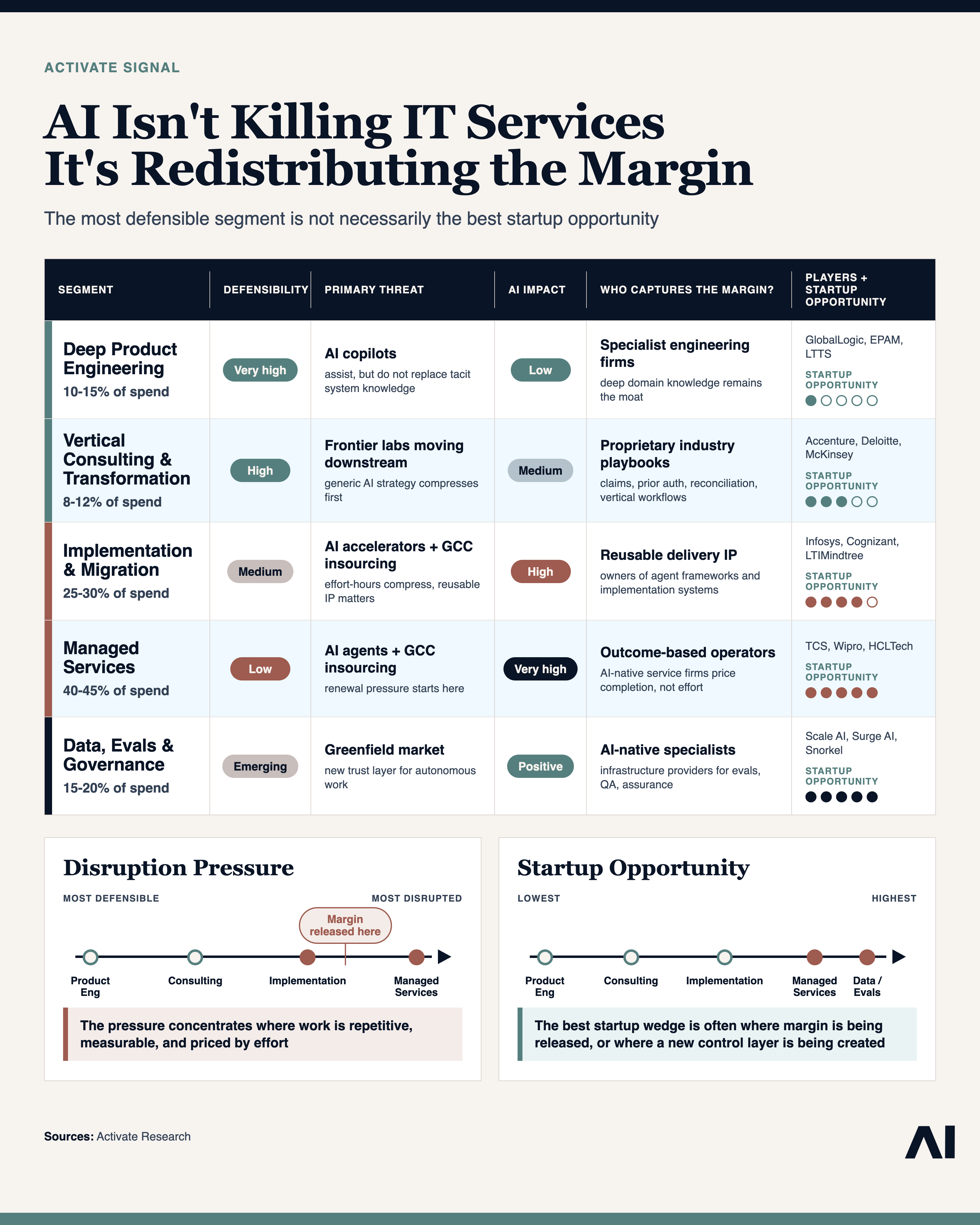
The easiest way to understand the sector is not as one monolith, but as five layers sitting on two different gradients: defensibility and startup opportunity.
Deep product engineering stays defensible because the work is dense with tacit context. Managed services come under maximum pressure because the work is repetitive, ticketed, measurable, and increasingly agent-addressable. Data, evals, and governance are the opposite - it is not being disrupted as much as it is being created.
The market is not collapsing. The margin pool is moving. The subtle point is that the most defensible segment is not necessarily the best startup opportunity.
Deep product engineering is protected, but that same tacit-knowledge moat makes it hard for new companies to enter. Managed services are less defensible, but that is exactly why margin gets released. Data, evals, and governance are still emerging, which makes it a new-company formation zone rather than a replacement market.
What IT Services Actually Are Today
Treat IT services as one monolith, and you miss everything. It is five distinct pools, and they sit on a steep gradient of defensibility.
At the most defensible end is deep product engineering: the shops building storage firmware, virtualization platform integration, networking stacks, and complex infrastructure software for global technology companies. This work demands fluency in proprietary architectures, multi-year product roadmaps, and the institutional context that lives in engineers’ heads, not in any public training corpus.
Vertical consulting and transformation comes next: designing the claims workflow, the reconciliation flow, the prior-auth process, the manufacturing exception loop, and the telecom support path. This is roughly 8-12% of IT spend, but with a high margin.
Implementation and migration - cloud migration, ERP/CRM rollouts, modernization, testing, integration - is the mid-margin middle, around 25-30% of spend.
Managed services - L1/L2 support, ticket resolution, QA, infrastructure ops, helpdesk, process operations - is the largest pool at 40-45% of spend, and the most volume-dependent.
Data, eval, and governance - model evaluation, red-teaming, domain training data, AI assurance, agent monitoring - is smaller today but growing fastest, around 15-20% and rising.
Where Each Piece is Under Attack
The competitive pressure hits each pool from a different angle, and the angle is what determines survival.
Deep product engineering: protected by tacit knowledge
Deep product engineering faces the least pressure. An agent can help an engineer write code faster here; it cannot replace the engineer who knows how a hypervisor change cascades through a storage stack.
The moat is tacit knowledge, which is by definition the part that never made it into the model’s weights. This is the last thing to be disrupted, not the first.
Vertical consulting: squeezed by frontier labs
Vertical consulting is squeezed from an unexpected direction: the frontier labs themselves.
When OpenAI stands up a deployment arm to embed engineers and redesign enterprise workflows, it is competing for exactly this layer. Generic “AI strategy” commoditizes. Only a proprietary vertical playbook holds.
Implementation and migration: compressed by accelerators, hollowed by GCCs
Implementation is compressed by AI accelerators and hollowed by GCC insourcing.
But it does not vanish. It re-prices. Margin shifts to whoever owns reusable delivery IP: connectors, migration playbooks, testing harnesses, eval suites, agent orchestration, and integration depth.
Managed services: hit from both sides
Managed services is the most contested pool, hit simultaneously by AI agents and by GCCs pulling the work in-house.
This is where renewal compression originates. The client does not have to believe in a full AI replacement story. It only has to believe that repetitive tickets, alerts, reconciliations, support flows, and exception-handling work should no longer be priced as if every unit requires the same human effort.
Data, eval, and governance: the greenfield layer
Data, eval, and governance face almost no incumbent competition because the category is still being formed.
Neither IT giants nor GCCs fully own it yet. But as copilots become agents, every regulated enterprise needs model QA, evals, audit trails, monitoring, compliance evidence, and assurance infrastructure.
This layer is not a cost takeout story. It is a market creation story.
The Disruption Vectors
Five mechanics are doing the actual work. They cut across every pool above.
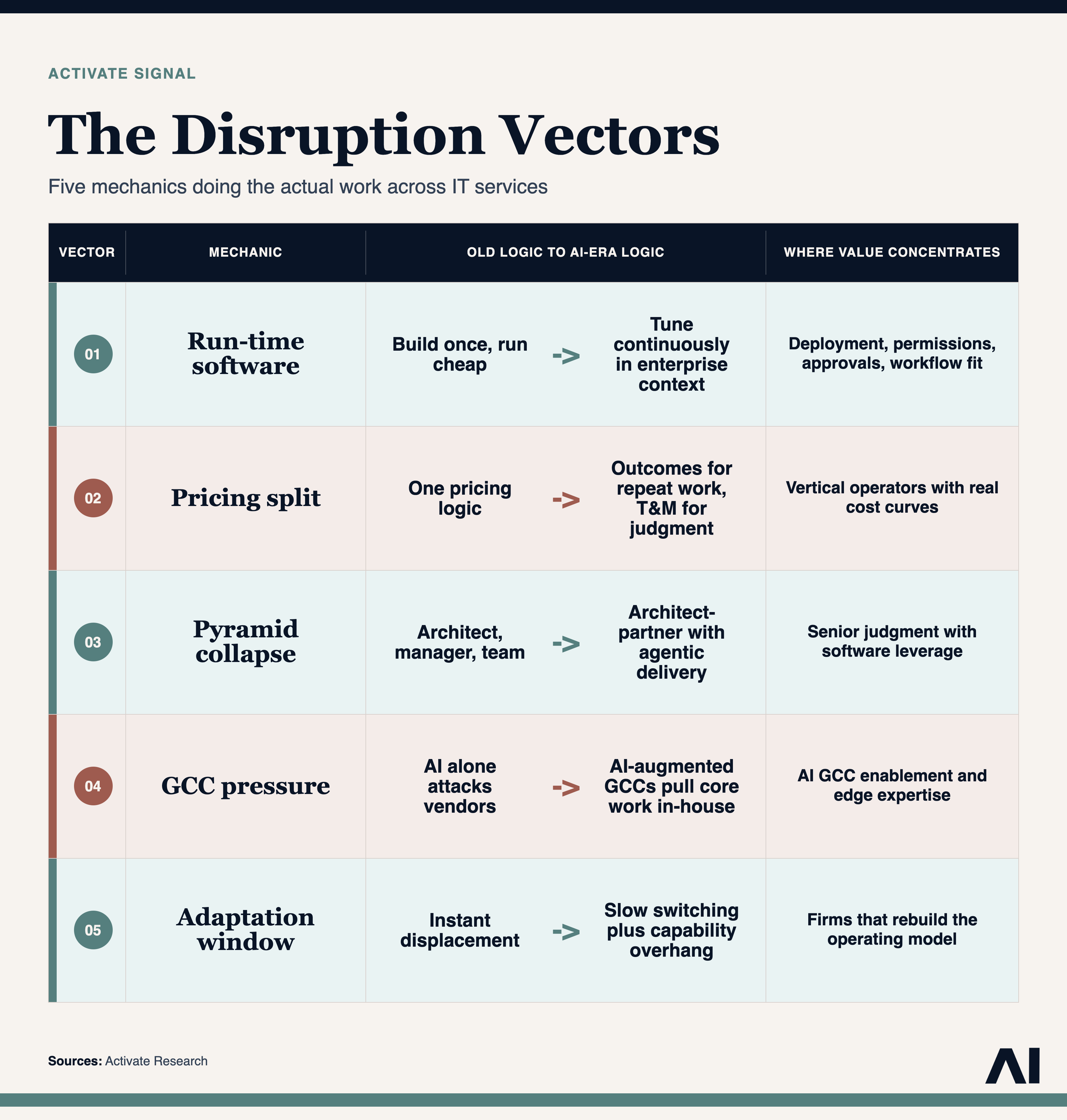
Vector 1: Agents are run-time software, not build-time software
Traditional enterprise software is a build-time asset: you spend the effort once, and it runs at near-zero marginal cost. The margin sits in the build, the same logic that lets SaaS write code once and sell it ten thousand times.
Agents invert this. The model is pre-built and increasingly commoditized. The value shows up at run-time, in the messy, per-customer act of pointing a general capability at one enterprise’s specific reality: legacy systems, access controls, compliance constraints, bad data, human approvals.
None of that compresses into a one-time build. It is continuous, contextual, local - which is to say, it looks like services.
This is also why deep product engineering is hardest to disrupt: the value there is precisely the run-time judgment that lives in the engineer. The thesis and its strongest objection are the same observation pointed in two ways.
When computing moved to the cloud, the margin did not go to whoever owned the server. It went to whoever could operate the workload against a specific stack. Agents run that play one level up.
Vector 2: Pricing splits along a bespoke/commodity line
The Valley reflex is “everything becomes outcomes-as-a-service.” The reality is more textured.
Outcome pricing wins where work is scoped, measurable, and repetitive: resolved tickets, processed claims, completed reconciliations. There it compounds. Price the outcome first in a vertical, accumulate data on what resolution actually costs, and pull away.
But in high-tech product engineering, engineering managers prefer time-and-materials because it preserves the flexibility to reallocate resources to whatever the roadmap makes urgent this week.
When the scope is genuinely uncertain, and the client is buying senior judgment, the option value of flexibility beats the predictability of a fixed price.
The endgame is not one winner. It is a split that mirrors how law and consulting firms already bill: hours for the bespoke, fixed-fee, and per-outcome for the commodified.
Vector 3: The delivery pyramid collapses into a partnership
The classic pyramid kept a delivery-manager layer between the architect and the team for a very human reason: architects do not want to be interrupted while writing the hard code, so someone else ran the people.
Agents dissolve that logic. The architect now delegates delivery to agents or runs delivery through them. The middle thins out.
What is left looks more like a law firm: a senior architect-partner who understands the system, manages the agentic team, and sells to the client. The three roles the old model deliberately separated collapse into one person with leverage.
The talent question flips from “can we hire enough engineers?” to “can we hire people who can make agents productive and own a client outcome?”
Vector 4: The bigger threat is the GCC, augmented by AI
Call AI the thing killing IT services, and you have named the weapon, not the hand.
The more direct threat is the in-house Global Capability Center. If incumbents get hollowed, it will be GCCs augmented with AI that do it, not AI alone.
The labs moving downstream confirm where the value is. In May 2026, OpenAI launched the OpenAI Deployment Company, a unit embedding Forward Deployed Engineers inside enterprises. A model company built a services arm. The model alone is not the product; deployment is.
Vector 5: Timing, and whether incumbents have time to adapt
Token costs are not zero. In the near term they are a real line item, and the implicit bet behind every “AI eats services” thesis is that the industry will not have time to evolve.
That bet is probably wrong.
No enterprise rips out its vendors overnight. Switching is slow, trust is sticky, and the binding constraint is human readiness, not model capability.
There is an enormous capability overhang right now. Most enterprises have little idea what these models can do, which means they cannot self-serve to value even with cheap tokens. That overhang is the services TAM.
But “survive” should not be read as “stay the same.” Every prior shift was labor-expanding. This is the first that is labor-substituting. The adaptable players will make it. They will just emerge as structurally different businesses.
The Five Wedges
That leaves the real founder question: if AI compresses the old services model, where does new company formation open up?
Our view is that the opportunity is not in generic “AI transformation,” but in the deployment layer where models meet enterprise reality: GCCs, regulated workflows, permissions, evals, and repeatable delivery systems.
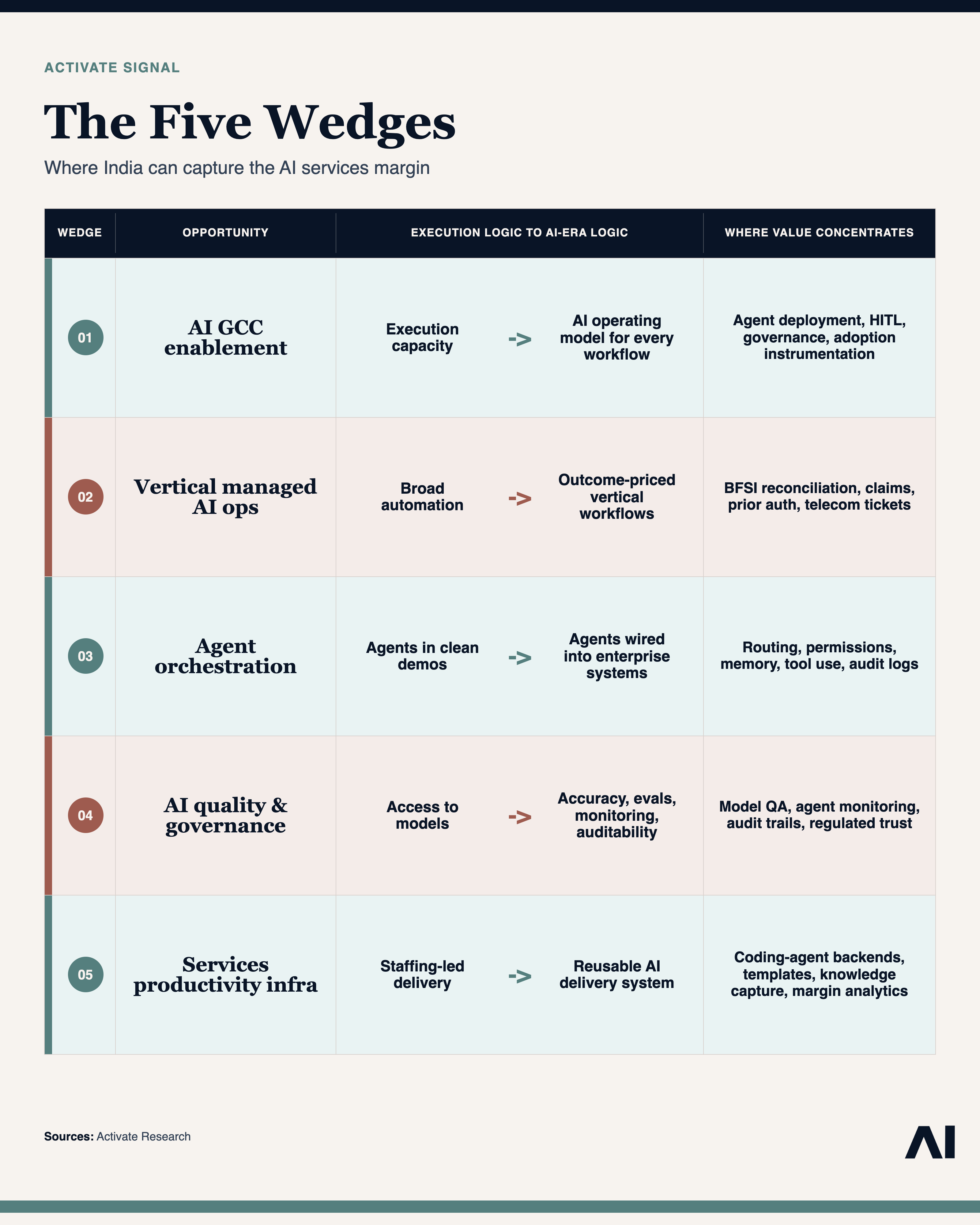
The common thread across these wedges is specificity. The best companies will not sell AI demos or cheaper hours; they will turn messy enterprise work into governed, outcome-priced workflows, using India’s implementation depth as the wedge into global demand.
One Corollary for Founders
The most defensible layer, deep product engineering, is also the least open to new entrants. The same tacit-knowledge moat that protects it from AI protects it from challengers. Low disruption and low new-company formation are the same coin.
The disruption and the opportunity both concentrate in the commodity and greenfield layers. Which is also why we are not in the “IT services is dead” camp. The adaptable incumbents and mid-caps, with distribution, domain trust, and switching-cost protection, will ride the transition.
The new company opportunity sits beside them, in the layers they are slowest to own.
The Bottom Line
AI does not kill IT services. It collapses the delivery pyramid, splits pricing along the bespoke/commodity line, and converges the whole industry on professional-services economics.
The margin trapped in headcount-heavy managed services and implementation is being released. The firms that capture it will not be better staffing businesses, but vertically deep, partner-led, agentic delivery firms that own workflow completion rather than workflow effort, operating as the intelligence layer inside enterprise GCCs.
The $98.4B GCC ecosystem is the distribution. The agent stack is the engine. Run-time is the real estate. And India, with the domain depth, the talent cost structure, the enterprise trust, and the GCC density already in place, is holding the deed.
If you are building in AI GCC enablement, agentic managed operations, evals, and governance, or vertical AI workflows in India, we would love to have a conversation to develop these ideas further.
India AI News Roundup
The most impactful AI developments & announcements shaping India in recent weeks.
Agentic platform Codex adoption in India up 27x since January, says OpenAI
India is now the world’s #2 Consumer AI market
Bajaj Finserv sets up ~$200M fund to invest in AI ventures
Anthropic sets up AI services company with Blackstone, Hellman & Friedman, and Goldman Sachs
OpenAI launches the OpenAI Deployment Company to help businesses build around intelligence
Startup Signals
Spotlighting brand new emerging AI startups from India every month, early and undiscovered.
FirstOps: Runtime control for enterprise agents
FirstOps is building the control plane for AI agents at work: identity, access, and audit across MCP servers, tool calls, LLM calls, skills, and subagents. The wedge is simple but structurally important. Enterprises want to increase agent usage, but security teams need a way to see what agents are doing, scope their permissions, and create audit trails before production deployment becomes acceptable.
Observal: The system of record for agent adoption
Observal is an open-source registry and observability platform for AI coding agents. It tracks agent usage across tools like Claude Code, Cursor, Gemini CLI, VS Code, and GitHub Copilot, with traces, spend visibility, adoption metrics, and agent registry primitives.
Terrastack: Spatial intelligence for Indian credit
Terrastack is building location intelligence for land and property decisions in India. Its public product gives plot-level assessments and map exploration; its April 2026 newsletter describes digital screening for Loan Against Property and branch intelligence for BFSI institutions, combining satellite imagery, government records, cadastral data, market data, and catchment-level accessibility layers.