
Imagine a familiar Friday evening. The cook sends a voice note saying she cannot come tomorrow. The school has moved a parent-teacher meeting to the morning. Someone needs to arrange lunch, find out who can attend the meeting, and change the plan already made for Saturday.
There is no especially difficult question here. There is a surprising amount of coordination. Products like Instinct and Meta’s Muse are built around the promise of taking some of that work off our hands. Connected to our apps and given permission to act, these personal agents can work on tasks beyond a single conversation.
For an Indian household, that could mean noticing the conflict from information the family has chosen to share, suggesting a revised plan and getting the necessary approvals. The agent would contact the right people, arrange a replacement cook, and follow up on the booking. If the replacement cancelled, the task would reopen. A reassuring message saying everything was arranged would count for little without a confirmed arrangement.
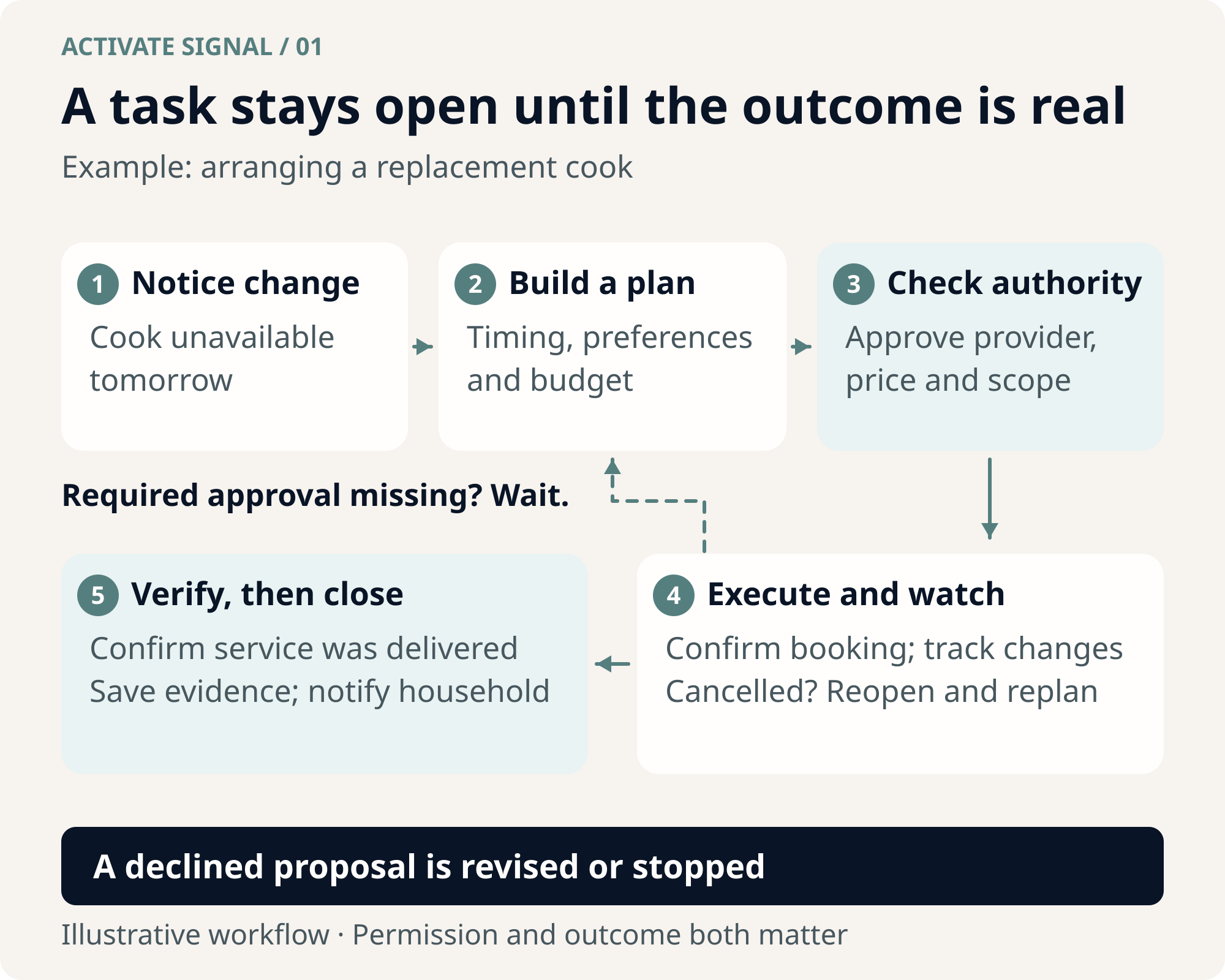
We think household coordination is the strongest starting point for an India-first personal agent. The work recurs, instructions arrive in scattered messages, and somebody usually has to make one more call. A company that reliably handles that last part can become useful well beyond a single booking.
We bet that the first durable India-first personal-agent businesses will grow from a few recurring household responsibilities. A founder needs to establish that people will delegate those jobs, trust the result, and keep coming back. A large population already using AI and digital payments helps. It does not answer those questions.
The category has moved beyond one breakout product
Instinct offers a simple interface: text or call an assistant connected to your applications and devices. Its public examples include following up on forgotten conversations and arranging a handyman. The appeal is easy to understand. An assistant becomes more useful when it remembers the circumstances around a request and can do something about them.
Meta launched Muse on September 08, with a dedicated cloud computer, a browser and access through its app or WhatsApp. It describes work continuing after the app closes, with approvals before actions such as purchases. By its September 29 update, Muse was available in the US and Canada and expanding into small-business workflows.
On September 29, OpenAI introduced dots: always-on agents with cloud computers and connected applications, rolling out across eligible paid plans and markets. OpenAI’s positioning includes ongoing work, proactive help and controls over consequential actions.
These launches put global distribution behind the category. Reliable delegation and mass-market economics still need proving, but a familiar chat interface and access to a capable model are already a weak foundation for a defensible Indian business. The question for founders is where they can deliver a meaningfully better outcome. To answer it, it helps to separate the machinery from the product.
What sits behind a personal agent
A personal agent combines a reasoning model with software that carries a job across time. For founders evaluating what to build, the following is a reference specification: requirements for dependable delegation, rather than a claim about any product’s private architecture.
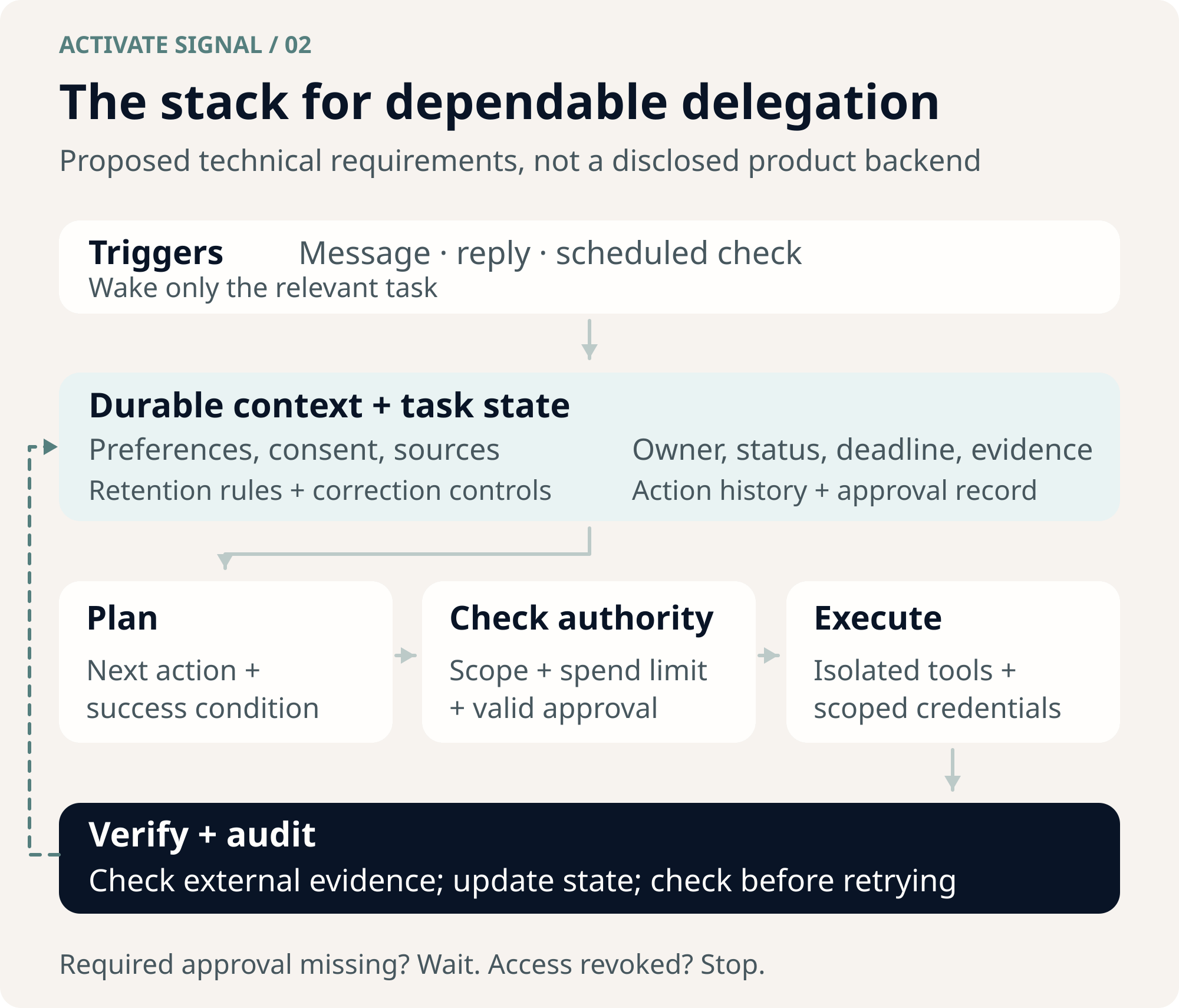
Inputs and triggers. Turn authorised messages, documents and replies into events that retain their source, time and uncertainty. Resume a task when something changes or an agreed check becomes due. An ambiguous voice note should not silently become a confirmed appointment.
Durable context and task state. Store the goal, responsible person, constraints, approvals, next step, and evidence of completion outside the chat session. Keep preferences separate from transaction state. “Prefers this electrician” and “visit confirmed” answer different questions; both need correction and deletion controls.
Planning and tools. Let the model propose steps and select tools with defined inputs and outputs. Use supported calendar, merchant, browser, or calling interfaces. The execution layer should validate the request before sending it and treat instructions found in external messages or webpages as untrusted content.
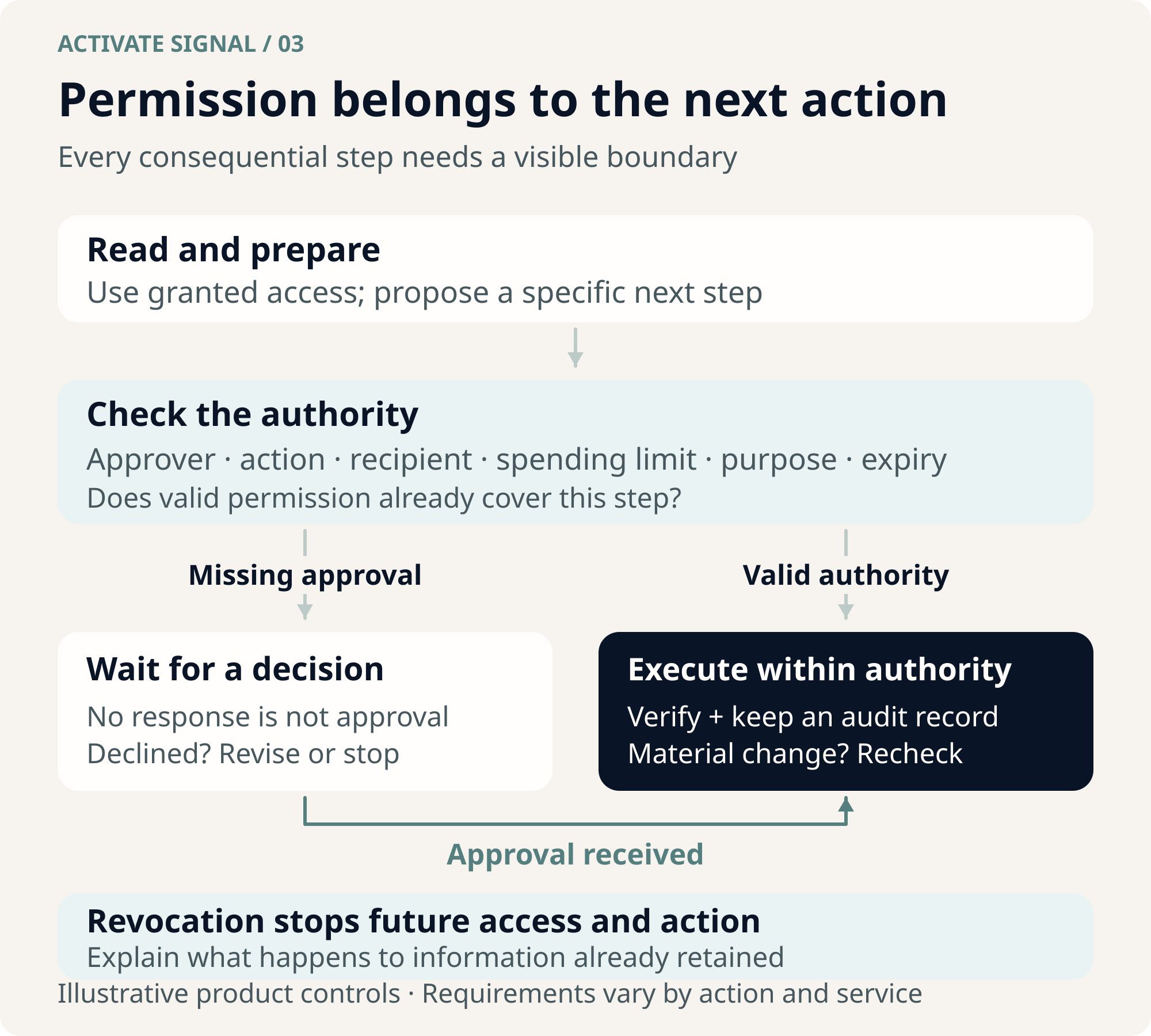
Authority and credentials. Put a policy gate before consequential actions. Check the recipient, data being shared, spending limit, and authorised approver; pause when permission is missing. Keep passwords and tokens in an isolated credential layer with narrowly scoped access, rather than in prompts or ordinary task history.
Execution and recovery. Save progress between steps, use timeouts and bounded retries, and stop when cost or effort exceeds the task’s limit. Use idempotency keys where supported so repeating a request does not repeat a purchase. After an uncertain response, check the actual transaction status before trying again.
Verification and feedback. Define what would count as success before acting: a supplier’s accepted booking, an updated appointment, or a refund receipt. Save the evidence and an audit trail of actions and approvals. A cancellation should reopen the responsibility; unresolved exceptions should reach the right person.
These requirements shape the economics. Better state reduces repeated work. Structured integrations and safe retries can lower support costs. Verification makes it possible to measure completed responsibilities and the human effort still required, rather than count reassuring messages.
The calendar has to be assembled
An assistant built around email and calendar access can be immediately useful to an office worker. Yet even that person’s household may have a separate coordination system.
A school circular arrives as a PDF. A housing-society notice changes the water supply for an afternoon. A clinic offers a token rather than an appointment time. The electrician says he will come after lunch. Payment reminders sit in SMS, while the conversation explaining a disputed bill lives elsewhere.
The mix varies by household. The product requirement is to turn these scattered inputs into a usable plan while preserving the difference between an informal suggestion and a confirmed arrangement.
“After lunch” should remain a window until someone narrows it. A school notice should carry its source so a parent can check the date. Religious observances, regional holidays, and meal preferences should be learned from the household’s instructions, rather than inferred from a surname or location. Access to one family member’s messages should never imply access to everyone else’s private life.
This also suggests a gentler onboarding path. Let the user forward a relevant notice or share one responsibility first. Demonstrate value before asking for broad account access. Demanding the entire household’s digital history makes for a difficult first sale.
Harsha Kumar’s recent Lightspeed essay makes a useful point about the “delegation gap”: many people do not know what to hand an assistant once the first few experiments are over. Household responsibilities offer a recurring reason to return. The tasks already exist; the product has to make them easier to hand over.
Finishing the job is a local problem
Knowing what needs doing is only part of it. A household agent must work with the channels through which the supplier accepts business.
For some jobs, that will be a clean API. For others, it may be an app, a website, or a phone conversation. A service can be digitally discoverable and still require a call to confirm the address, explain the problem, or find out whether anyone is coming.
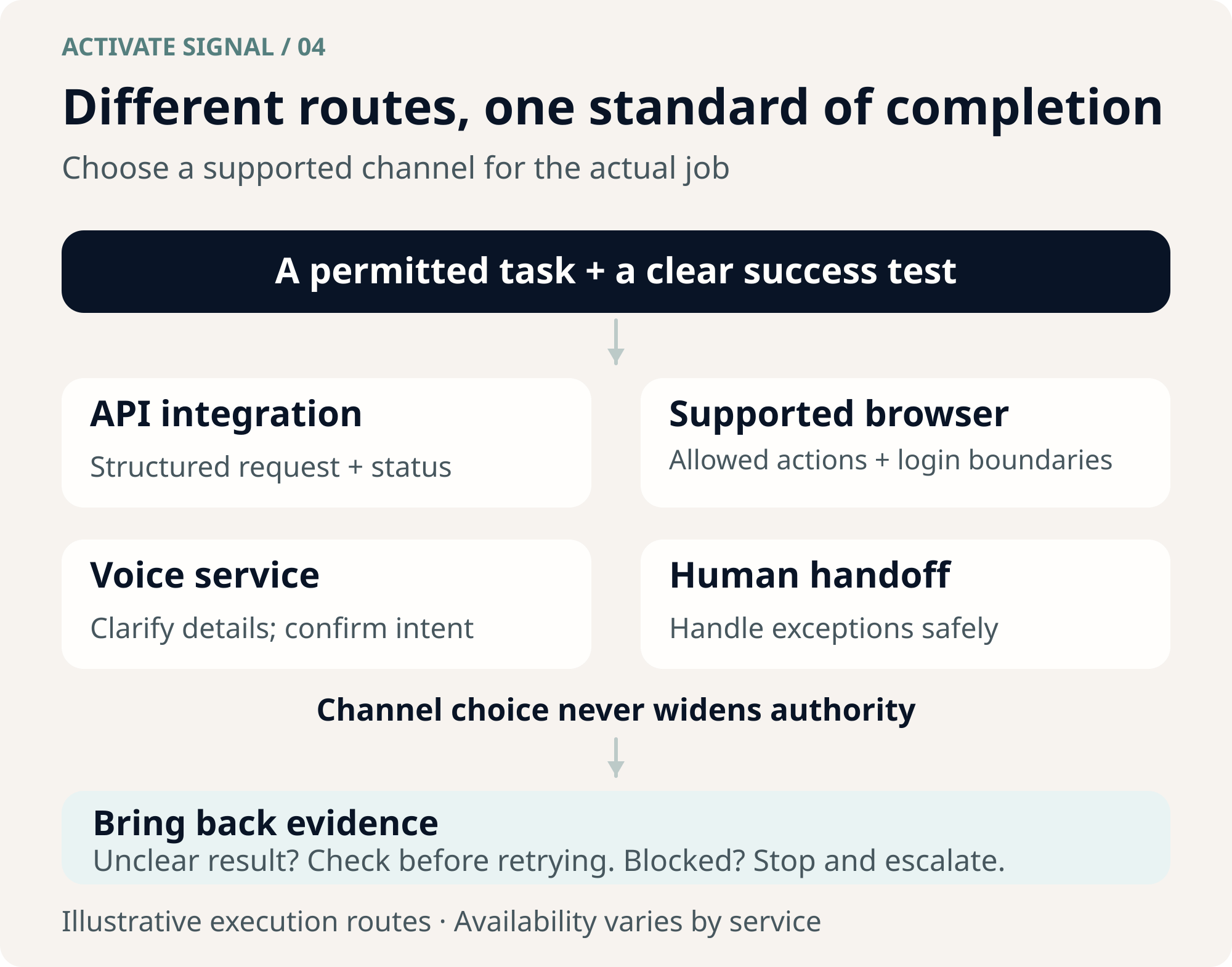
An effective voice system needs to handle interruptions, uncertain answers and language switching. It should identify itself appropriately and know which commitments it is authorised to make. A fluent transcript is a weak success measure when the plumber has misunderstood the building name.
Mobile access brings another constraint. Android offers possibilities for integration, but it is not a blanket licence for autonomous app control. Google Play’s Accessibility API policy restricts autonomous initiation, planning and execution, with a narrow exception for qualifying accessibility tools. A consumer agent cannot assume that user consent alone makes that distribution route permissible.
Payments offer real progress with important boundaries. NPCI’s extension of UPI Circle includes approved AI software profiles in a limited closed-user-group deployment for domestic merchant payments. Full delegation is bounded by ₹5,000 per transaction and ₹15,000 a month. It does not authorise any agent to spend from any UPI account.
UPI Reserve Pay provides a merchant-specific block of up to ₹10,000 for up to 90 days, under its specified conditions. Razorpay’s Claude commerce announcement describes a small-group pilot. These are credible building blocks for bounded commerce, rather than proof that general autonomous checkout is solved.
Three places to earn a household’s trust
Our ranking depends on the business a founder wants to build. Home operations offers the strongest frequency for the right urban household. Coordinating parents’ needs has the clearest potential payer: an adult child who already spends time and money managing the work. Household administration can assemble the broadest picture of recurring obligations. We would choose one of these starting points and make expansion depend on what customers actually delegate next.
Household administration
Start with the person keeping track of school fees, utility bills, renewals and receipts. They might be managing everything themselves or dividing it with a partner. Either way, much of the work consists of remembering what is due, locating the relevant information, and checking that someone dealt with it.
A first product could accept forwarded bills and notices, assemble a shared schedule, and prepare the next action. When a bill is unusually high, it can show the difference and ask the user to check. Once a permitted payment is complete, it stores the receipt and updates the status. It should recognise existing Autopay arrangements so its enthusiasm does not produce a duplicate payment.
The initial value is visible: fewer missed obligations and less time searching through messages. Over time, the product learns who owns each job and how the household handles exceptions. That becomes a strong basis for taking on adjacent work.
Financial integrations require a regulated route. RBI’s Account Aggregator framework supports consent-based sharing with regulated financial information users; an assistant needs a qualifying implementation or partner. Account Aggregators themselves do not execute transactions.
Household commerce
For households that employ domestic help or frequently book home services, the recurring job is coordination. Someone handles leave, changes the meal plan, arranges a substitute, and explains the same address again.
An agent could begin with one workflow: when the regular cook is unavailable, propose an alternative within the household’s budget and preferences. It confirms the time and price through supported channels, gets approval where required, and checks that the booking is accepted. If the household already has a trusted substitute, it should use that relationship rather than automatically pushing a marketplace order.
The difficult cases will matter most. Two people may give conflicting instructions. The replacement may arrive late. A worker may ask to reschedule directly. The agent needs clear ownership of the decision and an easy way for everyone involved to correct the record.
This product has a plausible path into recurring grocery and maintenance coordination because it already knows the household’s plans. Expansion should follow demonstrated usefulness. An assistant that still mishandles substitutions has little business taking on every household service.
Coordinating care for parents elsewhere
An adult child living in another city may be willing to pay for help keeping appointments, arranging transport, collecting documents, and following up with service providers. The parent may prefer a phone conversation to another app. That gives the company a clear buyer as well as a user to serve.
Consider an appointment that changes. With the parent’s permission, an agent could confirm the new slot, rearrange the ride, and tell the authorised family member what changed. It can prepare a checklist of records to bring and follow up on whether the administrative steps are complete. The child gets visibility without needing to make every call.
The parent’s agency is central. Paying for the service should not give the child unrestricted access to medical information or authority over decisions. The product needs separate permissions for scheduling, sharing records, and involving other people.
India’s health infrastructure can support this coordination, but an ABHA number does not itself give an agent access to a clinical history. Record availability, participating services, and specific consent still matter under ABDM’s record-sharing framework.
Who pays for the work?
The most ambitious version of the thesis puts the personal agent upstream of consumer commerce. A user asks for groceries; the agent compares eligible options and routes the order. If it reliably brings a merchant incremental business, the merchant has a reason to pay.
That could support a free consumer product in transaction-heavy categories. It is much less convincing as a universal business model. Reading a school notice, resolving a scheduling conflict, or chasing an existing refund may create substantial value without creating a commissionable sale.
We expect different models to fit different jobs. A household might pay a subscription for dependable administration. An adult child might pay for parent coordination. An employer or membership provider could bundle a bounded service. Merchant fees could fund specific transactions, provided the economics and incentives are disclosed.
Cheaper delegation should increase the number of jobs users hand over. That is good for engagement, but can worsen the business if most extra work earns nothing. Margin depends on how much of the workload is commissionable, what subscriptions cover and the cost of completing everything else.
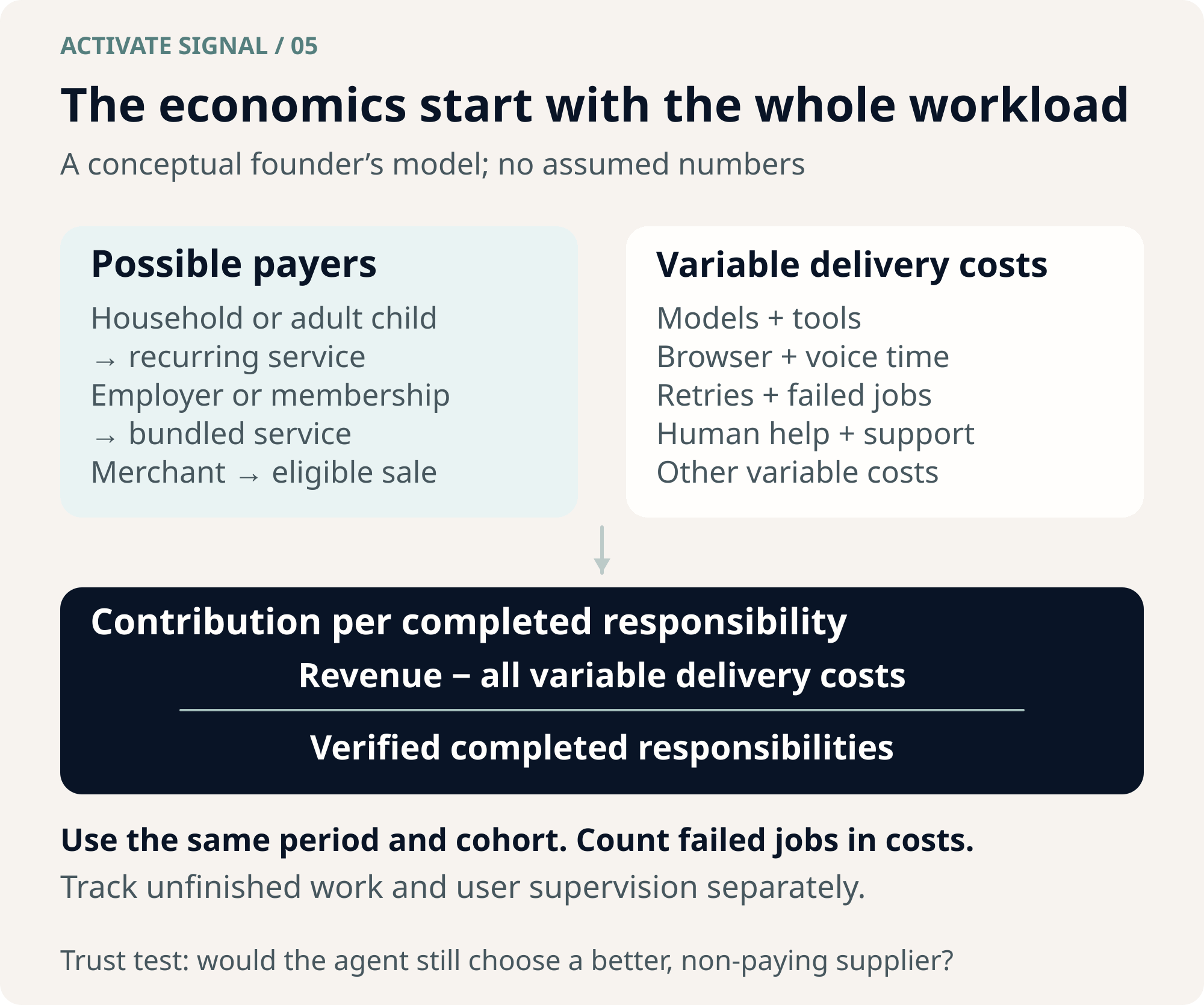
Founders should measure contribution margin per completed responsibility, including those failures and support costs. The cost of a successful demo is an incomplete denominator. They also need to know how much user effort remained: five minutes of supervision for a two-minute errand is a bad exchange.
Merchant funding creates a separate test of trust. If one service pays a higher commission, will the agent still recommend the option that better fits the user’s budget and timing? The answer must be visible in the product: disclose sponsored placement, explain important trade-offs, and preserve the ability to choose a non-paying supplier. “Best” needs a definition the customer recognises.
Platforms have bargaining power too. A marketplace may welcome an agent that brings new demand while resisting one that merely reroutes existing customers and asks for a fee. Participation in an early pilot does not settle that negotiation. The agent needs something valuable to offer, whether demand, lower servicing costs, or a customer relationship people choose to maintain.
Distribution has the same tension. Messaging makes an assistant easy to reach, but a company dependent on one platform inherits that platform’s rules and commercial priorities. An app, a phone channel, and portable household records can provide continuity. These choices cost money and add onboarding friction, so they need to serve a real user need.
Where an Indian company can win
Localisation gets a company into the market. A durable advantage needs to grow from completed work. Each resolved job can teach the product which supplier responds, where a workflow breaks, and what the household accepts as a good outcome. Used with permission, that feedback should improve completion rates and reduce intervention. If it merely generates more messages, the company has collected activity rather than built an advantage.
Service integrations add another layer: confirmed availability, reliable status updates, and refunds are hard to replace with a better prompt. Distribution matters just as much. A trusted housing, employer, or care relationship may reach a household more effectively than another generic assistant download. These advantages have to show up in retention and cost to serve.
The labs can supply intelligence and bundle assistants. Large consumer platforms control access to merchants and existing customers. An independent company earns its share by owning a responsibility that crosses those boundaries and that the household chooses to keep with it. There is no guarantee that this becomes one giant consumer front door; several specialised businesses may capture more value.
We would back the team that can show families returning, handing over more of the same work and needing less supervision, with margins improving as they do. The starting promise can be small. Making an ordinary, changeable week run better is a substantial enough business to begin with.
India AI News Roundup
India is considering a ₹15,000–20,000 crore Frontier AI & Compute Fund
Sarvam Vision 2.1 adds Indic handwriting and structured extraction
Pine Labs and Google Cloud target India’s agentic-commerce stack
NPCI unveils FiMI Banking and open agent evaluations
Prime Focus backed Brahma AI raises $150M at a $2B valuation
Startup Signals
Early companies we are watching because they sit at different control points in the compute stack.
Equal AI and the everyday interruption
Equal AI handles incoming calls with live transcripts, summaries, and user takeover. Routine interruptions give it a frequent, concrete job. The test is whether it saves attention while reliably recognising urgency and escalating important calls.
Kookar and the existing kitchen
Kookar coordinates meal planning, groceries and cook instructions over WhatsApp for households that already employ a cook. Its private launch tests a daily workflow with a clear outcome. Watch how much coordination stays manual and whether households keep paying.
Hulp and the human service layer
Hulp offers personal assistance for repairs, travel, and household follow-ups, with human assistants supported by AI. Its Delhi NCR pilot keeps customers in control of bookings and payments. The business test is whether automation lets each assistant serve more households without weakening service quality or margins.
If you’re building in this space, we’d like to hear which responsibility your users are already willing to hand over.
Sharp thesis, Pratyush. The coordination tax you describe is exactly what we see in Indian travel agencies - an enquiry lands on email or WhatsApp, sits for hours, and the customer books with whoever answered first. We are building NAMA (getnama.app), and its agent layer EKLA, on that premise: enquiries answered in minutes from the agency's own mailbox, quotes drafted from the agency's own rates, a human approval step kept wherever money moves.
Two things from the trenches that back your argument: the wedge is not the chat, it is the follow-through plus the audit trail of who approved what; and Indian SMBs will pay for completed responsibility long before they pay for seats. The Razorpay pilot you flagged is the rail we watch closest ~ the day an agent can collect on an approved quote inside the chat, this category explodes.
The section on coordinating care for parents makes permission granular in a useful way. Scheduling, record sharing, transport and clinical decisions should not collapse into one blanket consent simply because an adult child pays for the service.