
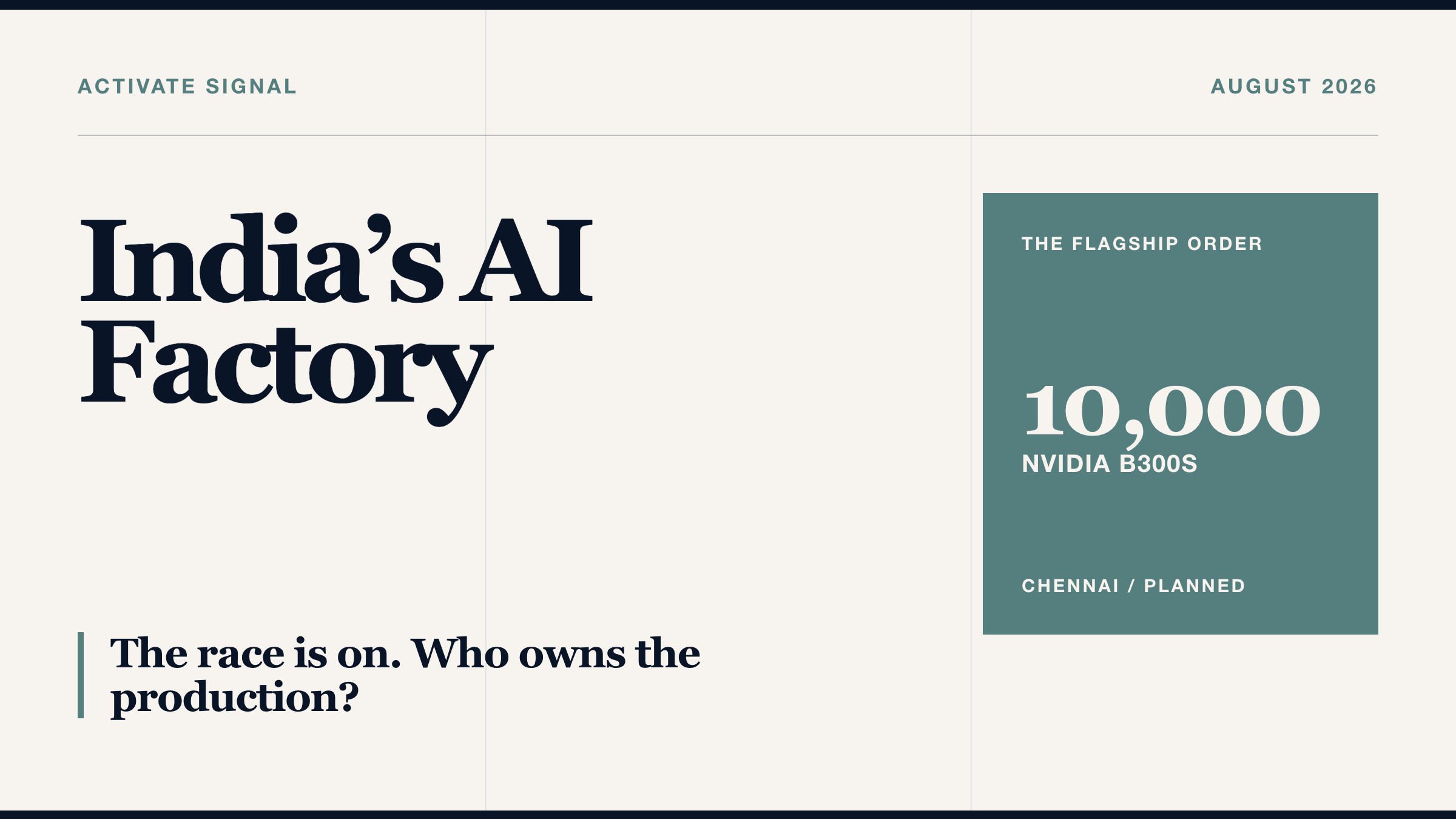
On August 13, Larsen & Toubro said its Vyoma AI business had secured a “mega” order from Together AI, a US-based AI cloud company. L&T classifies Mega orders in the ₹10,000–15,000 crore band, although it did not disclose the value of this contract.
The plan is to deploy one cluster of 10,000 NVIDIA B300 GPUs at L&T’s Chennai data-centre campus for training, fine-tuning and inference on Together AI’s cloud. The release does not say when the GPUs will arrive, when the cluster will be energised, or how much capacity end customers have reserved. That combination - clear physical roles, opaque commercial terms - makes the order useful.
NVIDIA supplies the accelerators. L&T supplies the campus, power infrastructure, systems integration and deployment. Together AI supplies the cloud platform. The site and power are Indian; the accelerator and cloud layers are not. Who acquires the end customer, sets the price, and retains renewal is not disclosed.
One order does not make an export industry. It shows how India can own the site, delivered power and operations while foreign companies supply the frontier accelerators and cloud layer. That is a substantial infrastructure business; it is not the same as owning workload allocation, pricing, and renewal. Our read is that India is moving from a primarily domestic colocation market into the global compute network. The buildout is real. The economic control point remains open.
The buildout is real. The denominator is not settled.
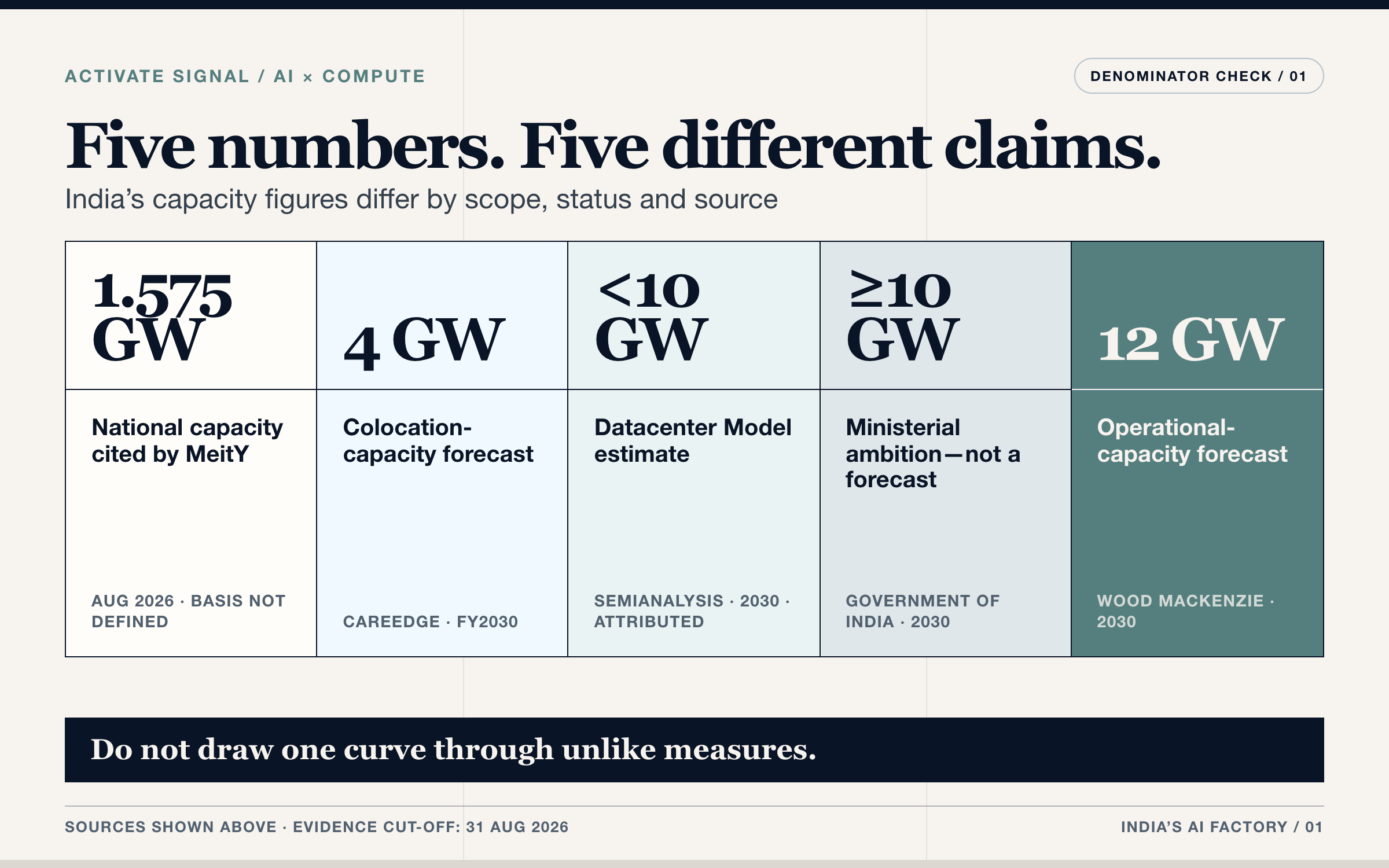
India’s data-centre base has expanded from 375 MW in 2020 to about 1,575 MW by August 2026, according to the Ministry of Electronics and Information Technology (MeitY). The government release does not define whether that is operational IT load, facility load, or another industry measure. The 2030 numbers diverge further. CareEdge projects Indian colocation capacity rising from 1.2 GW in FY2025 to about 4 GW by FY2030. Wood Mackenzie starts with a broader 2.2 GW base in 2025 and projects 12 GW of operational capacity by 2030. SemiAnalysis lands below 10 GW. The government has called for at least 10 GW by 2030, but that is a policy ambition, not commissioned supply.


Monday morning’s Economic Times front page adds a sixth number: JLL’s mid-year estimate that Indian data-centre capacity will triple from 1.6 GW in mid-2026 to 6 GW by 2029. It sits above CareEdge’s roughly 4 GW and well below Wood Mackenzie’s 12 GW. What changed is not the forecast but the sourcing: the tripling narrative has moved from consultant decks to the front page, still a projection, not commissioned supply.
These are not five points on one capacity curve. They describe different scopes, statuses and sources.
Even a settled number would conceal a second distinction. A megawatt of conventional colocation is not interchangeable with a megawatt built for current accelerators. AI-ready capacity needs denser racks, different cooling, and much more network throughput. Sify’s planned 103 MW across Navi Mumbai and Chennai, for example, is described as purpose-built for AI-ready workloads. Both the technical specification and the delivery status matter.
The named projects still show a genuine change in scale. Google broke ground in April on a gigawatt-scale AI hub in Vizag, part of a broader $15 billion 2026–30 package spanning compute, power, fibre and subsea connectivity. Google says the hub is intended to power services globally. It is the clearest announced version of the export-compute thesis.
Reliance has agreed to develop a 168 MW built-to-suit facility in Jamnagar for delivery within two years; Meta will lease it for its global infrastructure. Microsoft made India South Central in Hyderabad, its fourth Indian cloud region, generally available on 6 August. A planned Meta facility, a live Microsoft region and Google’s broader infrastructure package cannot be added into a clean national total. They establish something narrower and more useful: global platforms have begun designing Indian capacity into much larger compute networks.
Not all GPU capacity created is equal
The market currently compresses several states into one word: supply. The IndiaAI Mission’s shared-access pool exceeded 45,000 GPUs by June. By 5 August, 237 projects had been sanctioned 93.18 lakh subsidised GPU-hours—9.318 million hours.
That is meaningful evidence of access policy and a demand pipeline. It is not one 45,000-GPU supercluster. The pool spans providers, chip vendors and hardware generations. Sanctioned hours are not consumed hours, and the government has not published how many became recurring demand at an unsubsidised price.
Private announcements need the same discipline. Yotta said in February that 20,736 B300 GPUs would go live by August. An April partner disclosure later gave 30 September as the expected completion date. As of 31 August, neither Yotta nor Gorilla had publicly confirmed that the full fleet was installed, accepted or live. Yotta also says it has a four-year engagement worth more than $1 billion for NVIDIA DGX Cloud capacity within the cluster. That is an announced anchor commitment. It is not evidence of independent paid utilisation, and it introduces buyer concentration.
Neysa’s 20,000-plus-GPU expansion sits earlier in the process. It has signed agreements for up to $600 million of equity and said it intended to secure another $600 million of debt, subject to documentation. We found no public confirmation that the full debt package had closed. Signed equity, intended debt, ordered chips and available compute belong in separate columns.
The same ET report is a tidy exhibit to reflect how not all GPU capacity created is equal. It lists nine major announced investments:
TCS HyperVault (Rs 70,000 crore, 1 GW, Telangana)
AWS (Rs 60,000 crore, up to 3 GW, Telangana)
Microsoft ($20.5 billion, capacity not disclosed)
Google with AdaniConneX and Airtel Nxtra ($15 billion, 1 GW, Vizag)
Yotta ($2 billion-plus, 60 MW scalable to 250 MW, Uttar Pradesh)
CtrlS (Rs 4,000 crore / 72 MW in Tamil Nadu, plus Rs 2,200 crore / 60+ MW in West Bengal)
STT GDC (Rs 4,200 crore / 45 MW, Tamil Nadu)
Sify Infinit Spaces (Rs 1,500 crore / 50 MW, Andhra Pradesh).
Every row is an announcement; the report itself footnotes the Microsoft figure as a broader India investment commitment, not data-centre capex. Against roughly $15 Billion of commitments, the same page reports that till now there is only 85 MW of new capacity delivered and 101 MW absorbed (~$3 Billion). Announced gigawatts are a claim about 2029. Delivered megawatts are the current fact.
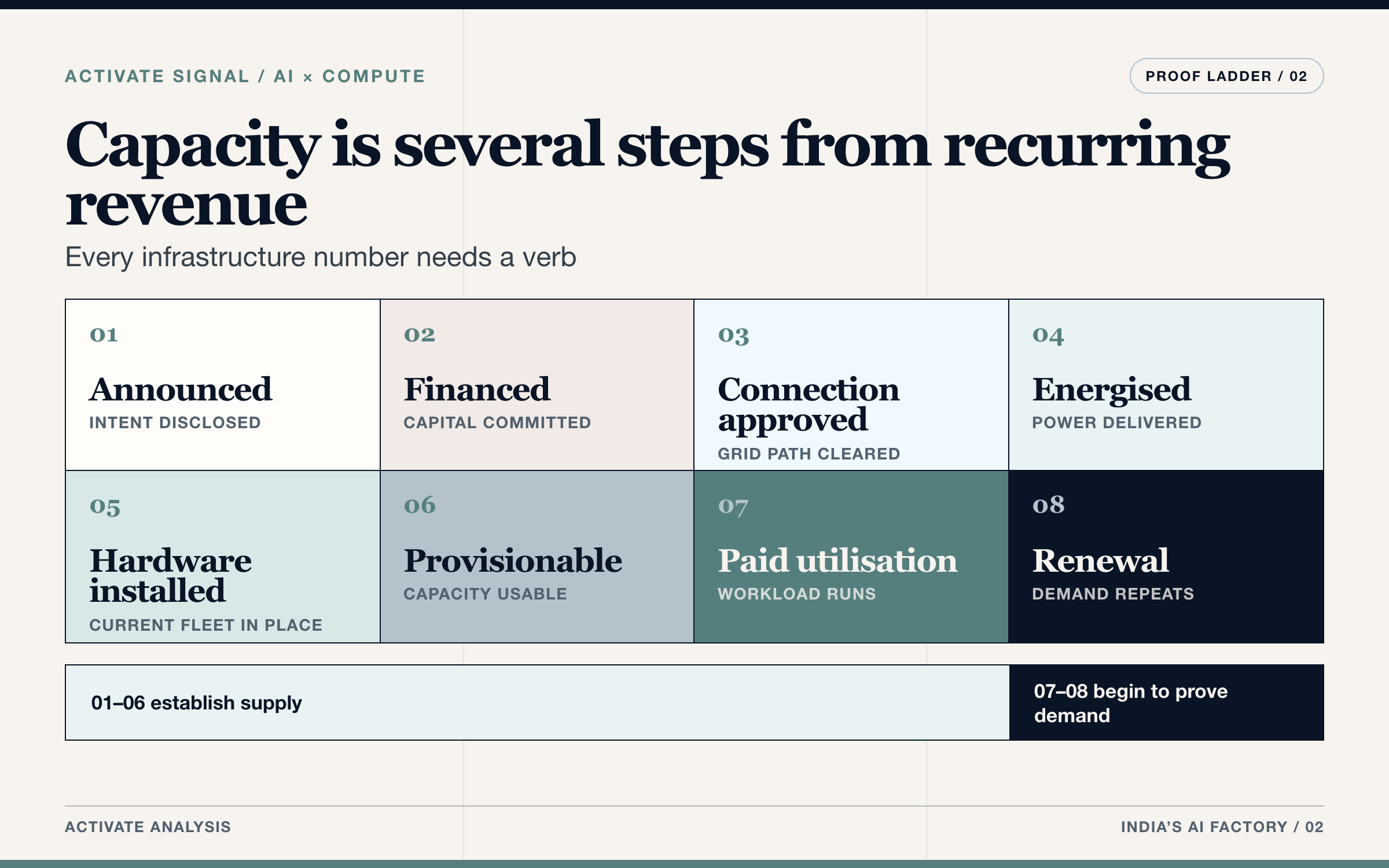
Every capacity number therefore needs a verb: announced, financed, connection-approved, energised, installed, provision-able, utilised or renewed. The number shrinks each time the verb gets stricter.
Why does Neysa exist if AWS exists?
Some AI buyers need things that general-purpose clouds do not always package well: contiguous accelerator clusters, predictable pricing, private deployments, hands-on support and a product built around AI rather than every possible computing job. Neysa and E2E are two Indian attempts to occupy that gap.
The pitch cannot stop at “rent our GPUs.” The GPU is inventory. The business has to add orchestration, observability, security and workload optimisation—and hold a customer relationship durable enough to survive falling rental prices.
The builders cluster into three operating models. These are strategies, not permanent company boxes: Yotta already spans infrastructure and cloud, while L&T is attempting the same through Vyoma and its proposed route to market with E2E.
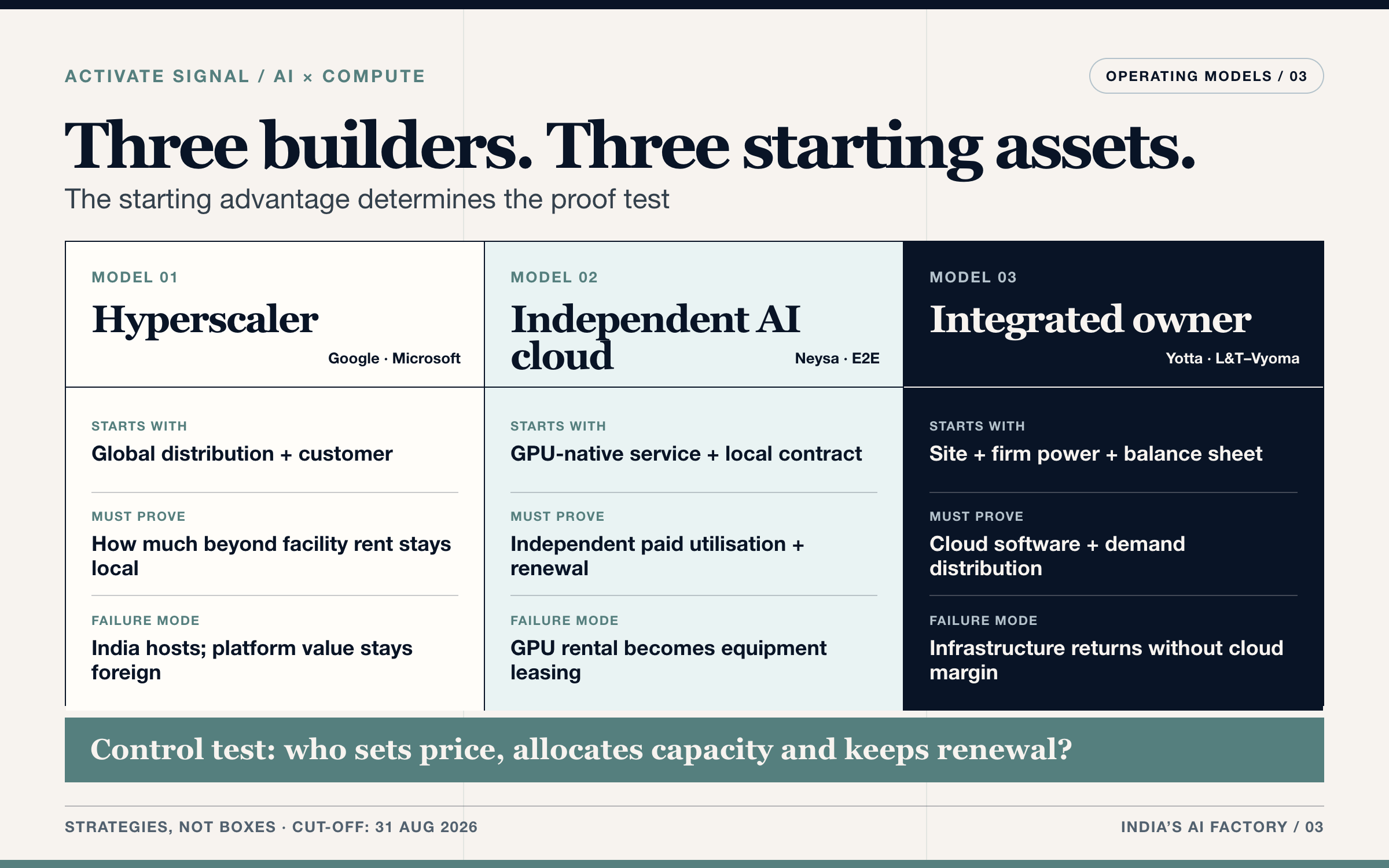
L&T held approximately 18.45% of E2E Networks at the end of June and had signed a framework MOU to commercialise Vyoma capacity through E2E’s TIR platform, subject to definitive agreements. No definitive agreement had been announced by the evidence cut-off. E2E separately reports about 5,100 live cloud GPUs, including 1,024 B200s. That is company-reported commissioning evidence. It is not proof of an integrated Vyoma–TIR offer, independent global demand, or attractive returns after depreciation.
The likely market structure is bilateral concentration. A small set of platforms and anchor customers control portable workload demand; a small set of hyperscalers and infrastructure groups control campuses and delivered power. Hyperscalers can sit on both sides. An independent supplier negotiates between concentrated buyers and concentrated upstream vendors.
The capital structure sharpens that imbalance. CareEdge observes capex financing with 70–80% debt, interest cover of two to three times, and two to three years before cash flow materialises across major operators. A good data-centre business can emerge from this structure. A good data-centre business is not automatically a venture business.
Data centres are now a state-level industrial-policy competition
The column the ET graphic includes is “party in power”. Telangana (Congress) holds the three largest announced tickets - TCS, AWS and Microsoft. Andhra Pradesh (TDP-led NDA) holds Google’s $15 billion Vizag package and Sify. Tamil Nadu holds CtrlS and STT GDC, and Uttar Pradesh and West Bengal hold Yotta and the second CtrlS project. Data centres have joined auto plants and semiconductor fabs as trophies chief ministers compete for with land, power allocation and incentives, and the siting decision now runs through state politics as much as through fibre geography. That cuts two ways. State competition accelerates approvals and subsidises power and land, improving project economics at the shell layer. It also means a campus’s advantage can be a political allocation rather than an operational one, and allocations can be repriced after elections. The durable moat is an energised, fibre-connected node in a cable-landing metro - which is why Mumbai and Chennai still account for nearly all new delivery: 48% and 50% of the 85 MW delivered in the half-year, per JLL.
Absorption is the honest number in the data. At 101 MW for the half-year - 20% above the three-year average, and above the 85 MW delivered - demand is running ahead of supply. That supports the direction of the build-out; it does not yet support the ticket sizes. TCS’s announced 1 GW alone is roughly ten times what the entire national market absorbed in six months; AWS’s ‘up to 3 GW’ is thirty times. Project blocks have already moved from 20 MW to 50-plus MW, which shows builders underwriting AI-density demand rather than conventional colocation. Whether absorption compounds into the gigawatt range, or the announced pipeline meets a slower demand curve, is the difference between the 6 GW story and an overcapacity cycle financed at 70-80% debt.
Cheap concrete does not make cheap compute
SemiAnalysis estimates that Indian data-centre construction can cost about $5 million per MW and that power is often available below $0.10 per kWh. JLL’s comparison supports the construction direction: it places Mumbai shell-and-core construction at roughly $6–7 million per MW, against $12–15 million in Singapore. That sounds attractive, but the footnote matters more: JLL’s figures exclude land and active IT equipment, while the AI technology fit-out can add as much as $25 million per MW. At that upper end, the fit-out bill is roughly four times the Mumbai building cost before land.
India can therefore have a genuine construction advantage without having proved a similar advantage in the cost of AI output. The useful unit is not dollars per shell MW. It is the all-in cost of completing a workload after accelerators, networking, financing, operations, electricity, cooling and utilisation are included.
Power moves that equation materially. One gigawatt of IT load running continuously consumes 8.76 TWh a year. Every one-cent difference in electricity price changes the annual server-power bill by $87.6 million, before cooling overhead.
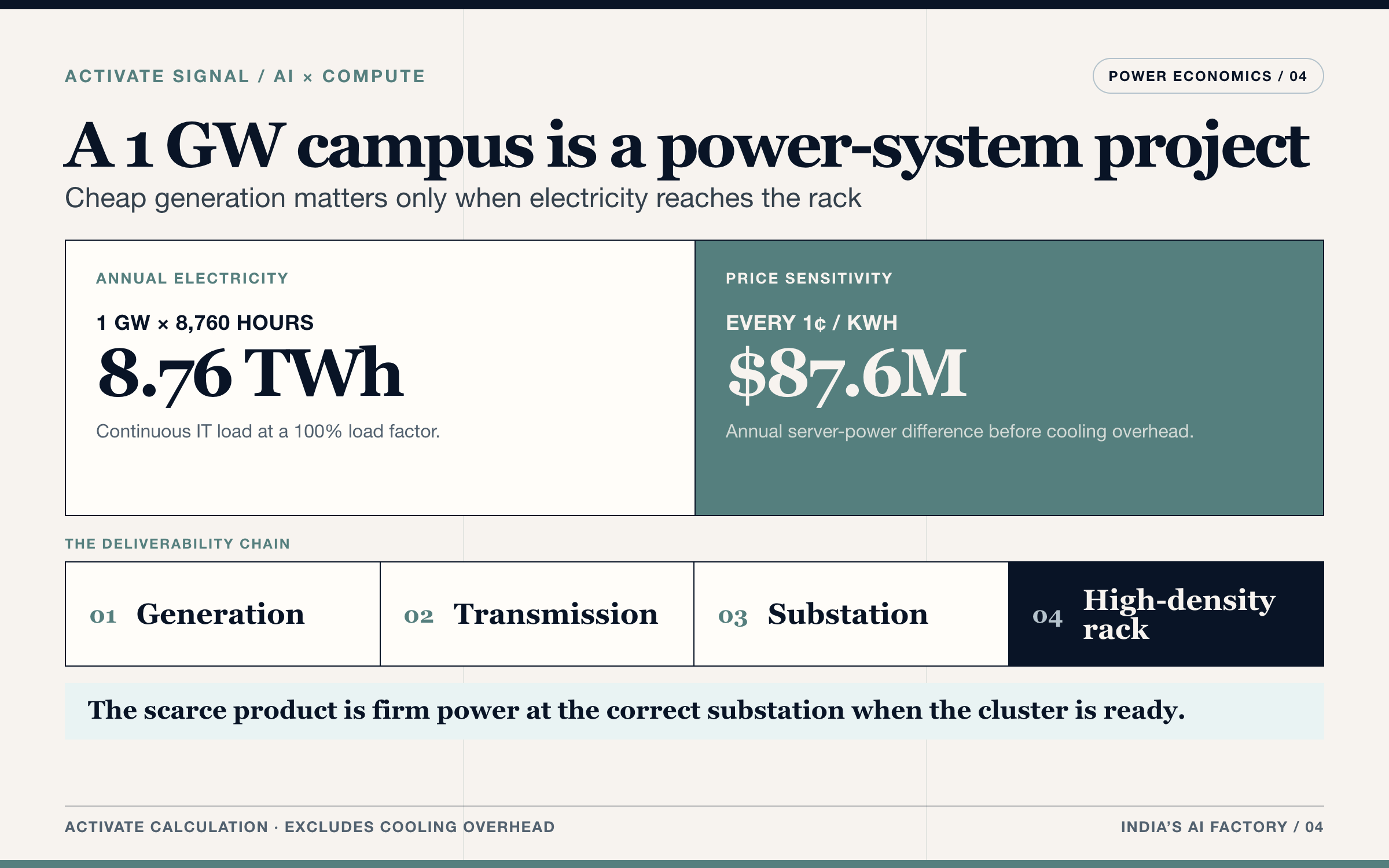
The relevant product is not a national average tariff or a renewable-power agreement. It is firm electricity delivered to the correct substation by the date the cluster is ready. CareEdge says aggregate generation is not the immediate problem; substation upgrades, transmission and power evacuation are. Google’s Vizag package reflects that reality by including generation, transmission and storage alongside the campus.
The scarce local asset is an energised, fibre-connected node that can support current-generation rack densities on a credible date. That creates valuable businesses in substations, power electronics, liquid cooling, storage controls, fibre and high-density operations, even while India imports frontier accelerators.
The export thesis still needs one comparison the announcements do not provide: India’s all-in cost per completed workload against Malaysia, the Gulf and other latency-tolerant compute locations.
The location can win while local suppliers lose the margin
There are four possible versions of an Indian compute hub. They differ on two questions: does the workload have to run in India, and how far does the local supplier reach beyond the facility?
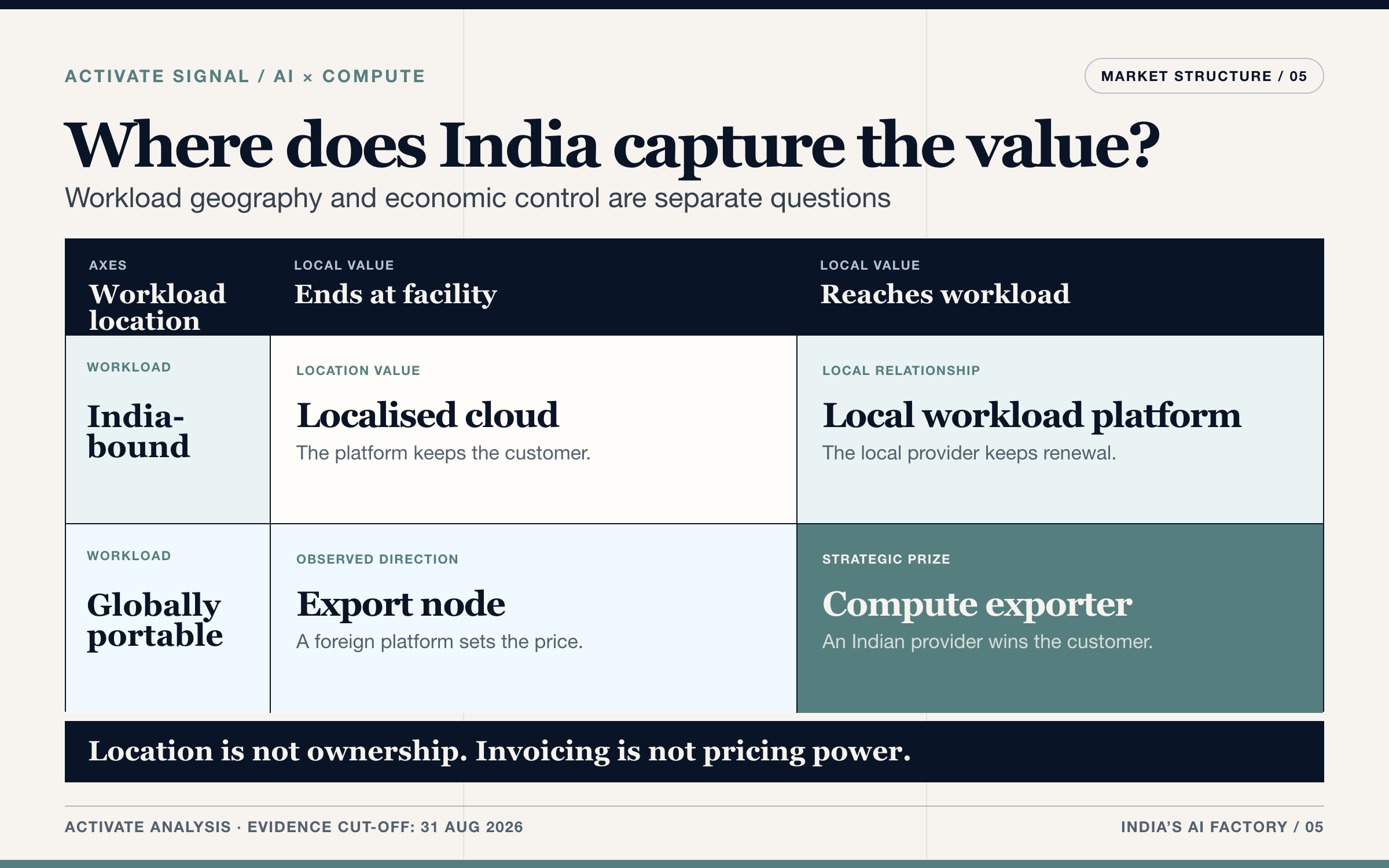
Banks, government, enterprises and consumer applications fill the top row. Latency and regulated-data requirements can make Indian capacity the natural home for those workloads.
Google’s stated global-serving capacity in Vizag and the Meta–Reliance facility sit in the bottom-left cell if commissioned and used as announced: Indian sites serve globally portable demand while the foreign platform retains the end-customer relationship. L&T–Together would land in the same cell if Together uses the Chennai cluster for portable workloads and controls customer renewal; the order does not disclose that demand mix or the commercial terms. These configurations could constitute compute exports. They would not yet prove an Indian compute-export business with local control over pricing and renewal.
The bottom-right cell is harder. An Indian provider has to acquire foreign demand, keep an expensive fleet occupied, match hyperscaler reliability and carry hardware whose rental price generally falls while it depreciates.
The proof is simple to describe. Who prices the workload? Who decides where it runs? Who keeps the renewal? Those questions also separate the layers economically. The powered shell can earn attractive infrastructure returns because the asset is hard to deliver and contracts are long. The thin GPU-rental layer is more fragile. It can look like software while behaving like leveraged equipment leasing: revenue begins when the chip is rented; depreciation begins when it is installed.
The more interesting venture layer sits around utilisation. Schedulers, inference systems, routing, observability and cost controls help customers complete more paid work on the same fleet. The strongest products own the workload decision and learn across hardware and clouds. The weak versions resell somebody else’s GPU-hour through a cleaner interface.
The bottleneck suppliers form another category. Power electronics, cooling systems, storage software and high-density operations sell into every builder. Some can become large companies. Venture returns, however, require repeatable products and technical IP. Project-specific engineering remains a services business even when the end customer calls it AI infrastructure.
Our base case is that India becomes a major regional market for inference, enterprise cloud and regulated workloads while hosting some global training and batch inference. A site or GPU fleet alone does not protect margin. The winner has to combine firm power, low capital cost, high utilisation, useful software and proprietary demand distribution. If anything close to 6 GW is built by 2029 while frontier training stays concentrated in a few global campuses, most incremental Indian megawatts will serve inference, enterprise cloud and regulated domestic workloads. Inference economics turn on utilisation and delivered power cost, not construction cost: at one gigawatt of continuous IT load, every 1 cent per kWh is worth $87.6 million a year. A 6 GW national build even at 60% utilisation makes state power policy - the thing the party-in-power column is really auctioning - a swing variable worth hundreds of millions of dollars a year to operators.
Three measures will decide it
Energised IT load fitted with current hardware. This removes land banks, MoUs, connection queues and delayed interconnections from the count. What can actually run?
Paid utilisation split by source. Domestic demand, captive global demand and independently acquired global demand are different proof points. Subsidised usage can start the flywheel. Repeat workloads at an unsubsidised price begin to establish recurring demand.
Economic control. Who sets the price, allocates capacity and retains the customer? What gross margin and return on invested capital survive electricity, financing, hardware depreciation and obsolescence?
If India reaches 10 GW of energised IT load by 2030, it will have built the factory. The harder measure is how much of that factory’s revenue comes from independent global customers for whom an Indian company sets the price and keeps the renewal.
India AI News Roundup
The most important AI developments shaping India’s market structure this month.
AM Intelligence reportedly ordered about 9,000 Nvidia Rubin GPUs on 25 August
OpenAI said self-service access to ChatGPT Ads would open in India later on 31 August
India’s AI funding momentum gathers pace as startups draw bigger growth cheques
India preparing rollout of agentic payments on UPI, sources say
AI reshapes India’s IT services sector contracts as clients demand more for less
Startup Signals
Early companies we are watching because they sit at different control points in the compute stack.
Simplismart: utilisation as the product
Simplismart says its white-labelled inference platform is generally available to NVIDIA Cloud Partners and other cloud providers.
Why it matters: scarce hardware creates supply, not necessarily margin. Software that completes more paid work on the same fleet can own the operating loop. The missing proof is production workload volume and the realised improvement in utilisation or gross margin.
OXMIQ: weaken the software lock around the chip
OXMIQ is building licensable GPU IP and a software layer intended to run CUDA-written workloads on non-NVIDIA hardware. Its OxCapsule product also attempts to pool heterogeneous compute behind one interface.
The strategic value is to weaken dependence on both imported silicon and the software ecosystem that determines which silicon developers can use. Production performance and paid adoption beyond company-reported betas and partnerships remain unproven.
Netrasemi: the edge is the counter-thesis
Netrasemi says its A2000 edge-AI system-on-chip has completed silicon bring-up and entered early customer trials, with commercial production targeted for 2027.
This is the counter-thesis to the gigawatt campus: cameras, machines and vehicles can move computation to the edge when latency, privacy or connectivity requires it. The proof gap is production yield, design wins, and repeat shipment volume.
The proof ladder is the useful frame here. Announced GPUs, energized capacity, paid utilization and renewal are different markets, and collapsing them into one supply number makes the buildout look further along than it is.